Publisher's Note: This article originally appeared in the Beaufort Observer.
The Battle of the Budget
This is the second in our series reviewing the 2011 session of the General Assembly. In this piece Brian Balfour of the Civitas Institute reviews the Battle of the Budget.
The 2011 North Carolina state budget is an historic one; it is the first state budget to be vetoed by the governor. Adding to its historic nature, the governor's veto was overridden by the required three-fifths vote in both the state House and Senate, making it only the second veto to be overridden in state history.
At first glance, there appears to be little difference in the legislature's budget plan that Gov. Bev Perdue vetoed and the budget she herself proposed a few months ago.
The General Assembly's plan spends a total of $19.68 billion, compared to Perdue's proposed total appropriations of $19.9 billion - for a difference of only one percent. According to Perdue's statements upon vetoing the legislature's proposal, however, she believed this minor difference would "cause generational damage to this state."
 NC General Assembly on the Mall photo by Stan Deatherage
And for a bit more perspective on the budget, it is important to note that a budget of $19.68 billion equates to half a billion more in spending than contained in the FY 2007 budget, and expands the state budget by more than one-third over the state budget of 10 years ago.
Despite the similar spending totals, the governor would have you believe there were some notable differences between what she desired and what was contained in the final budget plan that she so vehemenntly opposed.
The three most discussed issues were: taxes, public education funding and state employee layoffs.
Taxes: An $840 Million Difference
In 2009, North Carolina lawmakers implemented more than $1 billion in annual "temporary" taxes. These taxes included a one-cent increase in the statewide sales tax, along with increases in the corporate tax and personal income tax. Each of these taxes was legislated to be temporary and expire after two years, with the sales tax rate being the last to expire on June 30, 2011.
The new leadership in the General Assembly was swept into power last fall in no small part based on their promise to balance the state budget while allowing all of these taxes to fully expire.
Perdue, however, had a different idea in mind. Facing a $2 billion budget hole, the governor was unable to craft a balanced budget plan on spending reductions alone.
Specifically, Perdue's plan called for an increase in the statewide sales tax by three-fourths of a penny. As of July 1, 2011, the state-level sales tax was scheduled to fall back to 4.75 percent (counties and some municipalities also levy a sales tax, typically 2 cents per dollar spent). In short, under Perdue's plan, the statewide sales tax rate would have been 5.5 percent on July 1 as opposed to 4.75 percent as it will be under current legislation. Estimates projected the three-fourths penny extra sales tax rate would cost taxpayers $826 million annually.
Moreover, the governor's proposal included a reduction in the state's corporate tax rate from 6.9 percent to 4.9 percent.
But because the corporate tax rate applies to a relatively small number of businesses, total savings from Perdue's tax reduction would have amounted to only a projected $115 million. Therefore, the combined impact of Perdue's desired tax changes would have yielded a net tax increase of roughly $710 million.
Conversely, the final budget passed over Perdue's objections does not include a sales tax increase or a corporate tax rate reduction. Instead, the plan includes a tax cut package focused primarily on small businesses. It features a tax exemption of the first $50,000 in business income for start-up and small businesses having gross receipts less than $825,000.
The tax exemption is projected to produce a tax savings of $131 million for the coming fiscal year, and savings of $336 million the following year. It is, however, targeted to sunset at the end of the 2013 calendar year.
The difference of $840 million in taxes clearly weighed heavily on Perdue's mind as she applied the veto pen to the legislature's budget bill.
"Tonight, the Republican-controlled legislature turned its back on North Carolina's long-standing commitment to our people to provide quality schools, community colleges and universities - all to save a penny," Perdue stated in a clear reference to the sales tax.
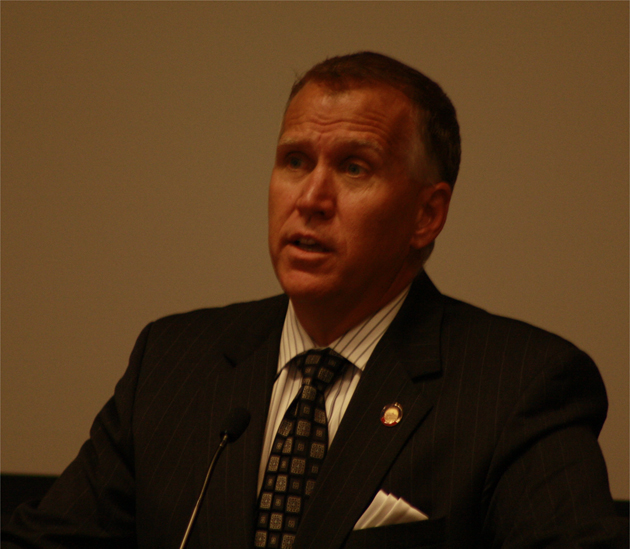 Speaker of the House Thom Tillis photo by Stan Deatherage
Conversely, House Speaker Thom Tillis (R-Mecklenburg) praised the new budget for offering relief to the state's economy and taxpayers. "This budget is fiscally responsible and economically sustainable," he said in a statement. "It reverses a decades-long trend of state government spending beyond its means and puts over a billion dollars back into the hands of North Carolinians. This is a good day for our state."