Wild Disturbances: Predator control deepens struggles for coexistence between wild canines, humans | Eastern NC Now
As he drove 50 mph across his pasture, it became more and more clear to Mike Corn that the coyote he was chasing was going to make it back to the safety of the trees.
Where do you stand on the Transgender Issue now that the issue has gotten to the overt point of the open celebration of this lifestyle choice, dictated by certain direct and explicit actions.
90.68% I do not approve of behavior that has within its expressed tenants policies that harm children.
8.47% I do support the Trans Community in all its many facets because diversity is at a premium in today's society.
0.85% What is a "Children's Drag Queen Story Hour?"
"We would never want them gone," Babb said. "On the other hand, we're very empathetic with the idea that you should be able to walk your dog and not worry about it getting eaten. This is the difficulty in managing wildlife. You've got conflicting demands."
During town meetings, Babb and the rest of the Game and Fish staff hear both sides of the story and strive for each party to view it as a responsive department. It seems as if the six million people in the Phoenix metropolitan area have six million opinions on predators, Babb said.
"People need to understand we're doing the best we can," he said. "We're trying to be realistic about it. As a biologist, oftentimes what I know that what needs to be done isn't what my heart wants to be done."
A controversial frontrunner
More than 5,000 wolves and an incalculable number of coyotes populate the lower 48 states.
Humans are not on the dinner menu for either of these animals. In United States history, just 30 coyote attacks and one wolf attack have been confirmed on a human. These statistics are low compared with those for domestic dog attacks, which resulted in 38 human deaths in 2012. Still, predator control helps ease the coexistence between wild canine and people. With livestock brought into the mix, the equation becomes more challenging.
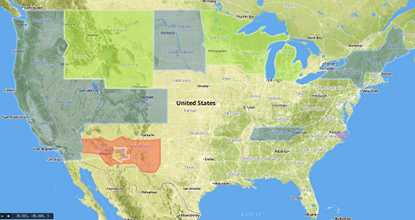
Click for interactive map of where wolves are today, where they could be in the future and the reintroduction areas of the Mexican gray wolf and red wolf.
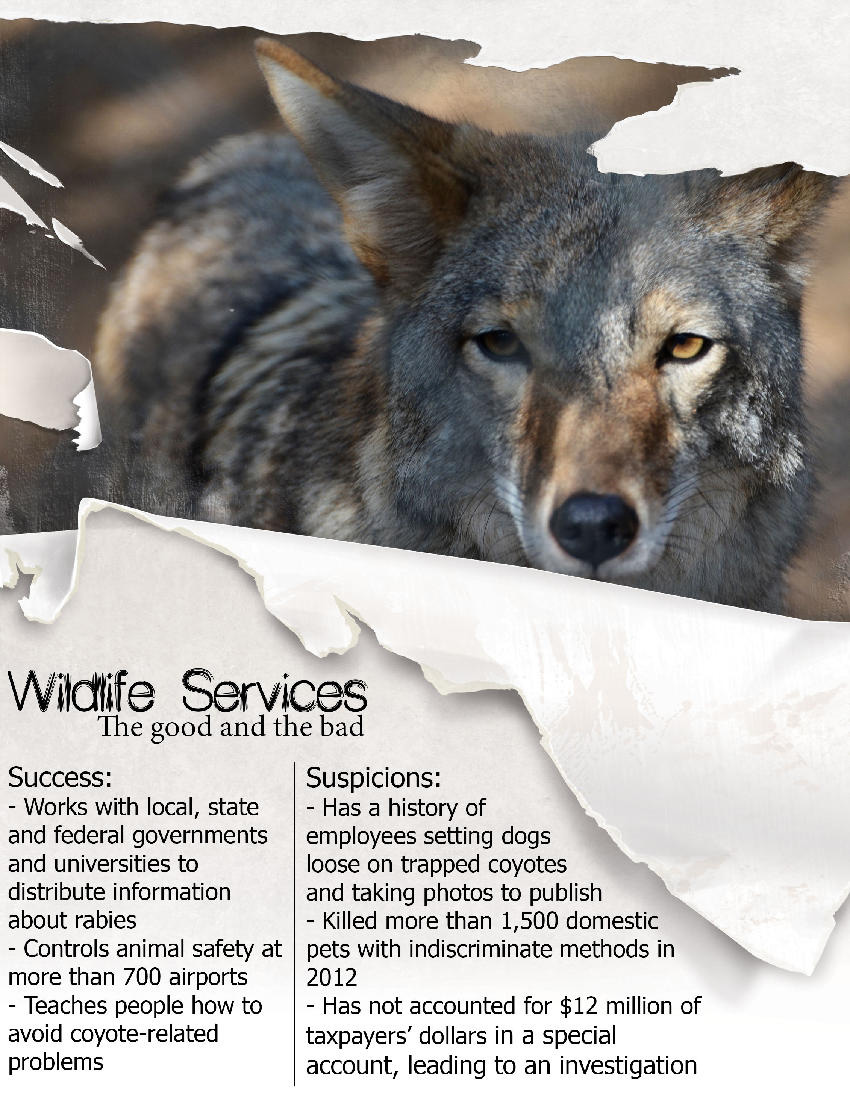
The U.S. Department of Agriculture's Wildlife Services is responsible for predator-control operations. Landowners can call the service for assistance, ranging from a wolf attacking cattle to a raccoon in an urban home's attic. The organization also attempts to resolve wildlife-human conflicts.
But sometimes, a mission is easier said than done.
People started inquiring about the necessity of the department after multiple reports of animal cruelty, accidental killings of endangered animals and domestic pets, and the death of more than 3 million animals via indiscriminate methods. When $12 million of taxpayers' money in a special account could not be accounted for, two congressmen decided to act.
Peter DeFazio, D-Ore., and John Campbell, R-Calif., requested the Office of the Inspector General of the U.S. Department of Agriculture to investigate Wildlife Services, according to a recent article in the Los Angeles Times.
The goal is to reexamine Wildlife Services' mission and how it spends its money.
"It's not a very transparent organization," said Keli Hendricks, owner of Rockin' H Ranch in California. "I think the type of people that go to work in the field - a person who wants to pursue a job trapping and killing animals - is not a person who's probably very concerned with conservation or nonlethal methods."
As a federal agency, Wildlife Services must go through regular audits and reviews. Some have been internally requested, said Carol Bannerman, U.S.D.A.'s Wildlife Services pubic affairs specialist.
"We have used external as well as internal reviews to make improvements in the program over the years," she said. "These are opportunities for an outside group to look at us and see what we're doing and how we can improve.
Wildlife Services has posted 16 years of records showing how they handle individual wildlife damage cases. They chase off 84 percent of all problem animals. Other times, they lethally remove or trap and relocate them.
Wildlife Services also tries to be more conspicuous with the National Wildlife Services Advisory Committee, a group of livestock producers, crop growers, animal welfare groups and private animal nuisance control operators that helps advise Wildlife Services on their actions.
One method Wildlife Services uses in some states is aerial shooting, which can cost up to $865 an hour and usually results in a single dead wolf or a couple of dead coyotes. Costs for other methods - from mass killings to individual kills - range from $100 to $2,000 depending on the individual circumstances.
While controlling wolf numbers has a strong impact on the species' population, a mass killing of coyotes has a very different effect.
"One of the really interesting things about coyotes shows that when you actually start removing animals they actually step up their reproduction to account for that attrition," Babb said. "That's a really remarkable behavior. It's pretty amazing to be able to do that."
DeFazio and Campbell are investigating if the public needs to be taxed when private businesses could do Wildlife Services' work for less money.
Lowell Cerise, owner of Cerise Ranch in Salmon, Idaho, said it would be better to have predator control regulated by the U.S. Fish and Wildlife Service or state agencies instead of Wildlife Services.
"I think Wildlife Services should be privatized," he said. "There are times when it's very necessary - when you're one of those families that's having problems. I just don't know if we need this big government agency doing it."
Bannerman said the role of Wildlife Services has changed over the past hundred years, like all other wildlife management professions. Instead of dealing with predator control, Wildlife Services mainly works to control depredations now, but people hang onto their former responsibilities.
"Sometimes the criticism and the image of Wildlife Services is more based on history than the current situation," she said.
Mixed bag of methods
Since 2000, about 50,000 non-targeted animals have been killed with undiscriminating methods. This human impact is partially why management is almost essential to reduce human-predator interactions, even though prey and predators naturally regulate themselves in the wild.
People have found solutions not only to keep their livestock and livelihood secure, but to ensure a healthy population of predators in the wild. Depending on geographic region, culture and personal experience, some landowners will protect their property at any cost while others are content to live with the wild at their front door.
Some people find guard dogs to be the most effective tool for protecting livestock from attacks. At Roswell Wool, Corn has more than 20 guard dogs. He said that many neighboring ranches died off from depredations and the dogs make up for the help he lost when his neighbors moved away.
But, predator control isn't restricted to the Western states. Farms in New England are reporting struggles with similar issues.
Click for story about one exterminator's experience with a rare-colored coyote.
Click for a story about a 21-year man who was stalked by coyotes.
Millerton sits near the border of New York in rural northern Pennsylvania. The town is home to just more than 300 people. Kathleen England of Glenfiddich Wool, said she, like many other residents, enjoys seeing wildlife, but after the farm lost 30 sheep to coyotes one spring, she decided to implement an unusual method: donkeys.
England bought Eeyore and Donkey Oaty for about $250 apiece. Donkeys live to be 25 to 30 years old, they stay with the herd through all weather conditions and they eat hay, like the sheep. In the past 20 years, England said they have lost only a few animals.
"I know that if my donkeys see a dog or coyote in the pasture and they don't recognize it, they're chasing it out of the field," England said. "If they can corner them, they'll kill them."
Click for a story about a woman who had to hide in a golf course bathroom to avoid a group of coyotes.
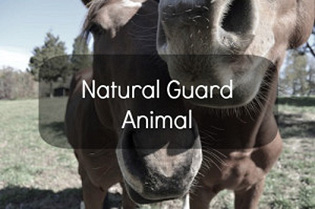
Click for a story about one man's horse who thoroughly enjoys chasing coyotes from the pasture.
She doesn't have any resentment toward the coyotes. She said if humans try to work against wildlife, they will not get anywhere, adding that coyotes need a place to survive.
"That's why we live where we live," England said. "I just don't want them eating my sheep. We actually have put a 30-foot wildlife buffer around our farm and when my husband does hay, he has this one coyote that will run behind the baler to get the voles [mouse-like rodents]. The coyote is so happy just getting these voles, throwing them up in the air and eating them."
Predator control doesn't always require guard animals. Sometimes, traps and snares do the trick.
Outdoorsman and recreational trapper Ryan Yoakum, one of the owners of All Exterminating in Cumming, Ga., has been in the exterminating industry for 15 years. He knows the chances of a person or dog stepping in traps in a rural environment is low. But in cities - coyotes are prevalent in nearly every city - he needs a whole new plan to avoid unnecessary injury.
While more controversial than any other technique, lethal methods are a quick solution for a constant depredation problem.
Texas allows lethal methods and actually offers a $100 bounty for coyotes. Using a lure, hunters can attract a coyote to an M-44 device. This spring-operated system attracts predators to pull on the baited top portion, which ejects sodium cyanide in its mouth and instantly kills the animal. This method also has a history of killing domestic pets and countless other non-targeted animals.
"It's not really my flavor, but if you're doing it strictly for elimination of them so that game animals can thrive, I can understand how that would be a benefit," Yoakum said.
When livestock or domestic pets are attacked, the U.S. Fish and Wildlife Service uses forensics to determine what type of animal cause the death. The distance between the teeth punctures is measured, and from there, experts can accurately determine the animal and develop a form of predator control best suited for that particular situation.
Strict supervision of predatory animals has been one of the popular methods, whether it's through the use of guard dogs or various traps. But some people argue against interrupting nature.
"I definitely don't think hunting them or killing coyotes is an option," said Valerie Maguire, a Cave Creek, Ariz. resident. "I think if you have one that has lost its fear of people, we've got a real problem."
When Maguire and her husband moved to Arizona, they decided they were going to consider themselves visitors and not interfere with the animals, especially predators, Maguire said. She goes for walks with her small dogs in the late mornings and brings bear spray just in case. She has a game plan should a coyote become too curious.
"If we see one, we make noises, we throw rocks," she said. "Anything you can to scare them.
Maguire works to ensure that her home does not become attractive to coyotes. She never feeds them or leaves her dogs or trash outside for long periods of time. Most people in Arizona know about the serious coyote threat to outdoor cats and small dogs.
But the methods residents use to keep predators out don't always work.
Melissa Gable, now the public information officer at Maricopa Animal Care and Control in Phoenix, used to work at the Arizona Humane Society. Her friend from the society had a house that backed up to an Indian reservation.
"It's open desert - prime area for coyotes," Gable said. "My friend actually had a neighbor who had a cocker spaniel, certainly not a dog you'd think a coyote would see as prey. A coyote jumped the fence and came into the yard, took the cocker spaniel, carried it back over the fence and took it off into the desert."
Although many pets are killed each year by coyotes, Gable does not think a large-scale predator control program for the coyotes is needed. "It seems like the feeling here is it's an issue, but we understand why it's an issue, so why should we blame the coyote for that?" she said. "We're the ones that made this an issue by building on their land."
Moving forward with education
At some point, most Americans have discovered ants in their homes. The most common answer to this problem is to get rid of them with household chemicals or to call an exterminator.
"It doesn't make a whole lot of sense if I come to your house and tell you, ‘No, you can't kill those ants. As a matter of fact, you have to give them a portion of your instant mashed potatoes and your bread and keep them over there and feed them. We're going to make it undesirable and illegal for you to manage them. Just share your stuff with the ants,'" said Ray Evridge of Phoenix Varmint Callers.
While ants and wild canines are controlled differently, the same problem exists - what if coexistence is uncomfortable?
Education is a strong tool and people directly involved with predator control are starting to use it to its full capacity. It not only helps change people's perceptions, but it also helps increase safety for humans and domestic animals.
"Arizona Game and Fish has a whole host of different things and mechanisms that we use to get the information out to people," Babb said. "These coyote issues are a part of the public education approach that we've taken, even to the point of having town hall meetings where we'll go out to an area where there happens to be problems and we'll hold a meeting, hear their concerns and tell them ways they can best prevent these types of incidents from happening."
Babb said since Game and Fish won't eradicate all coyotes from urban areas, education is the most reasonable approach.
"What we need to do is get a community base-type action plan that discourages the animals from hanging around," Babb said. "A good part of this is hazing. We want people to throw objects at coyotes, yell at them, stomp their feet, clap their hands - do anything that would scare those animals and make those animals shy of human beings, which would eliminate a lot of the problems."
Nemeth said the Grand Canyon Wolf Recovery Program talks to students and the public to dispel rumors about the wolves and emphasize the wolves' importance in the ecosystem.
"We try to have a presence at public meetings, have people write comments, make phone calls, write letters and emails," Nemeth said.
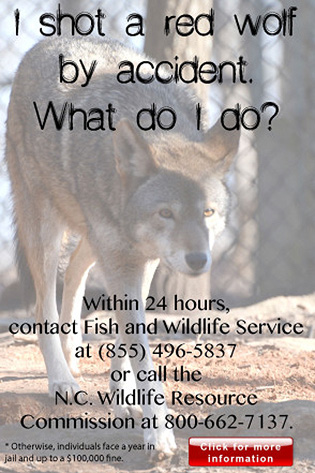
Education is also a critical aspect of the Red Wolf Recovery Program in North Carolina, where it is more directed toward safeguarding red wolves. Bartel said the program is showing recreationalists and hunters who live around the wolves how to identify a coyote from a red wolf to reduce accidental killings.
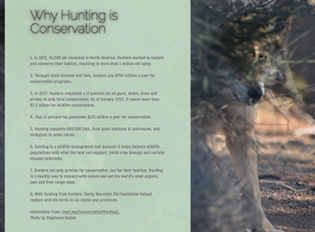
Although many people find it hard to believe, hunting is a form of conservation when done properly. Click to enlarge.
Equipped with education, people have started molding a coexistence between humans and species of endangered wolves and coyotes. These predators play an irreplaceable part in the ecosystem, but for the public to be safe, it is necessary to guide and restrict their interactions with people.
"It's a small planet and there're a lot of other things that share it with us," Babb said. "It's really important to leave room for all those things and try to do the right things as best you can."
* This in-depth was completed as an independent study. Please click here for my comments, motivation and other information concerning this article.