The story of America is one of liberty. It is a beautiful story. It is one which represents the culmination of man's search for protected freedom - for the "invaluable blessings of liberty" and the "inalienable rights of mankind." This search of course ended with the Declaration of Independence and the Constitution, which were written by great men with brilliant minds who were determined to secure those blessings of liberty "for generations to come and millions yet unborn." [Anti-Federalist Papers, Brutus I]. So much of our future is tied to our understanding and respect of our past.
While the age-old search for liberty may have culminated with the birth of the United States, the Declaration of Independence and the Constitution weren't the first of their kind. Enshrined in these documents are the themes from some of the greatest charters for liberty - the Magna Carta and the English Bill of Rights of 1689. The Magna Carta was a product of the Medieval Era, which was a very exciting time in English History. Feudal laws, and then the Magna Carta itself, formed much of the basis of English law, called the English Common Law. By the seventeenth century, England began to expand. It was the first great age of the British empire and was characterized by commercial and colonial expansion in the West and the East, including the New World. There was also a great struggle for power at home between the Crown and Parliament. It was against this backdrop that such important documents as the Petition of Right of 1628, the Habeas Corpus Act of 1679, and the English Bill of Rights were enacted by Parliament. As the Common Law continued to evolve during this century, enriched by judicial decisions and constitutional enactments, the fundamental principles which they embodied were added to the Common Law heritage that "Englishmen" embraced in the colonies.
Just 560 years or so before Thomas Jefferson sat down to draft the Declaration of Independence, a group of barons assembled at a place called Runnymede, England (close to the place where Windsor Castle would later be built), to confront their despotic ruler, King John. These barons were owners or "lords" of northern estates in England. King John had lost a lot of money the previous year in a war against King Philip to reclaim French lands he had inherited. He then attempted to rebuild his coffers by demanding that all barons who had not supported or joined his war with Philip pay a fee (called "scutage" - which is a fee paid in lieu of military service). The barons demanded that King John respect the Coronation Oath given by King Henry I in 1100 which promised to limit the king's ability to obtain funds by taxation. But King John refused to honor this Oath and continued to demand scutage. The barons soon became rebellious and demanded that the king acknowledge a stipulation of their rights. The rights were listed in written form and initially referred to as the "Articles of the Barons." King John and the barons worked together to make some changes and final provisions, and on June 19, 1215, he signed the document and affixed his Seal. This document then became known as the Magna Carta, or "Great Charter." (King John later renounced the charter, claiming that he was under duress when he signed it, but his son later reinstituted it). The Magna Carta introduced the Rule of Law. It became a "guideline" (although it was considered the "Supreme Law" of the land at the time) for how the King was to regard his subjects. The primary purpose of the Magna Carta was to force King John to recognize the supremacy of ancient liberties, to limit his ability to raise funds, and to reassert the principle of "due process." Of great significance to future generations was a minor wording change with respect to whom the great document was intended to protect. The term "any baron" was changed to "any freeman." Over time, and especially as the feudal era ended, it justified the application of the Charter's provisions to a greater part of the population. While freemen were a minority in 13th-century England, the term would eventually include all English persons, just as "We the People" would come to apply to all Americans.

Winston Churchill stated in 1956: "Here is a law which is above the King and which even he must not break. This reaffirmation of a supreme law and its expression in a general charter is the great work of Magna Carta; and this alone justifies the respect in which men have held it."
The author, Rudyard Kipling, wrote:
"At Runnymeade, at Runnymeade
Your rights were won at Runnymeade!
No freeman shall be fined or bound,
Or dispossessed of freehold ground,
Except by lawful judgment found,
And passed upon him by his peers.
Forget not, after all these years,
The Charter signed at Runnymeade.
To understand the Magna Carta, one must realize that England at the time was a feudal society. In a feudal society, the king's barons held their lands `in fee' (feudum) from the king. In return, the baron would declare an oath of loyalty and obedience, and would be obliged to provide him with a certain number of knights whenever they were needed for military service. Since the land was held "on condition" to the king, the king could also impose additional rights, demands, or exactions (such as what would be required if there were no male heirs to fight, extra taxes, selling daughters in marriage, assuming guardianship of the land and confiscation of profits, and even demanding forfeiture). The Magna Carta, therefore, through its 63 clauses, listed the barons' rights, demanded limitations on the king's abuse of power with respect to the feudum, and demanded rights of redress. And though many of these clauses later became obsolete, were amended or deleted, the Charter nonetheless became the basis for English Common Law which went on to become the basis for American law. Some of the most important provisions were those of the right of habeas corpus (the due-process right to challenge one's detention or imprisonment) and the pronouncement that the Charter was to be the supreme law of the land... one that could not be altered by the king or any other ruler (could not be altered by executive mandate or legislative acts). These provisions were later incorporated into the U.S. Constitution in the Fifth Amendment (Due Process clause) and in Article VI (Supremacy Clause).
Why was the Magna Carta so significant in 1215? That answer takes us to the Battle of Hastings in 1066 where King William (William the Conqueror) of Normandy (northern France) defeated Anglo-Saxon King Harold II for the throne of England. The result was that the invading Normans and their descendants replaced the Anglo-Saxons as the ruling class of England and stripped them of their rights and privileges. Prior to the Norman Conquest, the Anglo-Saxons enjoyed certain freedoms. Kings weren't oppressive authoritarian figures. In fact, they often shared power with certain government officials called "Earls." But that all changed in 1066 when King Edward (Edward the Confessor) died without children - without an heir. The throne passed to an English Earl named Harold II, whose only claim was that he was friends with Edward and his wife. When William II, Duke of Normandy, found out, he laid claim as the rightful heir to the throne. He was, in fact, Edward's cousin. When Harold II refused to give up his claim to the throne, William took it by force. Under the new ruler, government would become very different in England. The people lost their voice. The "king" was to be the principle authority figure and serve as the collective executive, judicial, and legislative branches of the government. It was the Magna Carta which reasserted certain fundamental rights of the people and began to define the role of government with respect to the people.
The Petition of Right was passed by the English Parliament in May of 1628 and recognized by King Charles I the following month. It was enacted just prior to the English Civil War. The document is extremely important because it sets out specific liberties of the individual that the king is prohibited from infringing. The Petition's most notable provisions are those that state that taxes can be levied only by Parliament, that martial law may not be imposed in time of peace, and that prisoners must be able to challenge the legitimacy of their detentions through the writ of habeas corpus. Note that the ban on quartering of troops was a very sore issue with the colonists and was later addressed in the US Constitution with the Third Amendment. The Habeas Corpus Act of 1679, passed by Parliament under the reign of Charles II, was a response to great public outcry against abusive and unlawful detention of persons. The Act provided that persons unlawfully detained cannot be ordered to be prosecuted before a court of law and reinforced the important individual right addressed by the Magna Carta. Again, the right to be free from unlawful detention or imprisonment is found in the Fifth Amendment to our US Constitution.

The English Bill of Rights was the next evolutionary document. Signed into law by King William III in 1689. It marked the next fundamental milestone in the progression of English society from a nation of subjects under the complete authority of a monarch to a nation of free citizens with inalienable rights. Angered by a long series of abuses of liberty by King James II during his reign from 1685 to 1689, members of the English nobility (known as the "Immortal Seven") sent a formal request or "invitation" to Holland's William of Orange and his wife Mary, daughter of James II to invade England and free them of their tyrant. English nobility promised to support the invasion and did so, making it virtually a bloodless incursion. William landed at in southwest England on November 5, 1688 with a large Dutch army and as he stepped ashore, he proclaimed: "the liberties of England and the Protestant religion I will maintain." Some of the abuses that King James II was guilty of include: suspending acts of Parliament, then disbanding Parliament (throwing the Great Seal into the River Thames), ignoring the Magna Carta and otherwise collecting taxes not authorized, interfering with popular elections, attempting to impose Catholicism on a staunchly Protestant nation (by persecuting Protestant officials and replacing them with Anglican ones), and repeatedly placing himself above duly enacted laws.
Shortly after Williams of Orange invaded England and ousted James, in January of 1689, Parliament became functional again and a Convention was then assembled in London to determine the succession of the English Crown. It was at this Convention that members of Parliament drafted a Declaration of Rights and offered the throne of England jointly to William and Mary, who thereafter ruled jointly as King William III and Queen Mary. This Declaration was adapted to create a Bill of Rights - the English Bill of Rights - and was signed into law. From that moment forward, it altered the balance of power between the sovereign and his subjects.
The Magna Carta and English Bill of Rights compelled limitations on government and therefore were monumental in reasserting the rights of the people with respect to their government. With each assault on the rights and dignities of citizens, and especially landowners, the English asserted their rights. And each time tyrant kings attempted to disregard the Magna Carta and prompted the English to re-assert their rights, they won greater and greater protection of their liberties. Fast forward to the American colonies. They too would have a tyrant king trample on their rights and dignities and they too would have to re-assert them. King George III would trample on their English rights just as King James II had done only 100 years earlier.
As we all know, the Pilgrims landed on Plymouth Rock, a granite boulder at Plymouth Harbor (now about the size of a cat) in 1620. They left England so they could worship freely and establish a church of their choosing. This period of time is particularly noteworthy because although the Magna Carta began to lose its significance in the centuries following 1215, it was resurrected by Lord Coke in the early 17th century. As Coke proclaimed: "Even kings must comply to common law." Lord Coke's view of the law was particularly relevant to the American experience for it was during this period that the charters for the colonies were written. Each included the guarantee that those sailing for the New World and their heirs would have "all the rights and immunities of free and natural subjects." Understanding theses documents, we begin to see the makings of America.
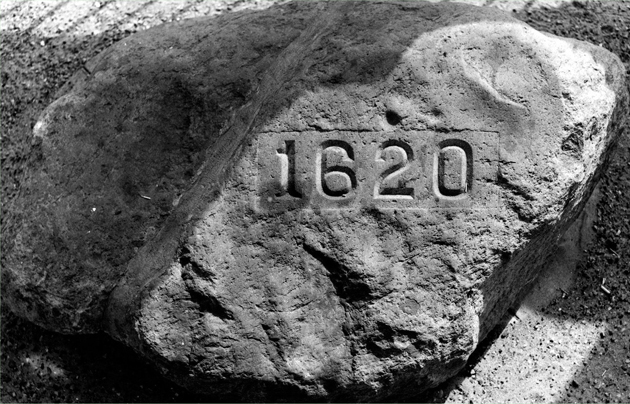 Plymouth Rock ... or what's left of it.
The colonists, even though they left Britain to settle on new shores, they did so based on Charters granted by their mother country. They considered themselves proud British subjects. The British mocked them and called them "Americans" which was a derogatory term, but nonetheless, the colonists, and even our Founding Fathers, considered themselves proud British subjects. They came to America's shores with the same protections of liberty that those in England enjoyed. In fact, when our founding Englishmen came to the "New World" to establish colonies, they brought with them charters guaranteeing that they and their heirs would "have and enjoy all liberties and immunities of free and natural subjects." As our forefathers developed legal codes for the colonies, many incorporated liberties guaranteed by Magna Carta and the 1689 English Bill of Rights directly into their own statutes.
At some point, Great Britain stopped seeing the colonists the same way the colonists saw themselves, and that began shortly after the French-Indian War. Britain had just waged that costly war against the French on behalf of the colonists (and to protect its own interests as well) and in order to offset the war debt, it passed a series of burdensome statutes on the colonies: The Sugar Act (1764), the Currency Act (1764), The Stamp Act (1765), the Quartering Act (1765), the Declaratory Act (1766), the Townshend Revenue Acts (1767), the Tea Act (1773), the Coercive Acts (aka, the Intolerable Acts (1774), and more Quartering Acts (1774).

In 1764, Parliament passed the Sugar Act which increased the duties on imported sugar, textiles, coffee, wines, and indigo (blue dye). The Currency Act prohibited the colonists from issuing any legal tender paper money. (This act was potentially disastrous because it almost destabilized the economies of both the more industrialized North and the agricultural South). A year later, Parliament passed the Quartering Act, which required colonists to house British troops and supply them with food, and the Stamp Act, which imposed the first direct tax on the American colonies. The Stamp Act marked the first time in the 150-year history of the colonies that Americans were required to pay tax not to their own local legislatures in America, but directly to England. Under the Stamp Act, all printed materials, including; newspapers, pamphlets, bills, legal documents, licenses, insurance policies, legal writs, almanacs, and even playing cards would have to carry a stamp showing that required taxes had been paid. Most legal transactions in the colonies ceased because nearly all of the colonists refused to use the stamps on such material. They also objected to the Act's provision that those who disobeyed could be tried in admiralty courts without a jury of their peers. Lord Coke's influence on Americans showed clearly when the Massachusetts Assembly reacted by declaring the Stamp Act "against the Magna Carta and the natural rights of Englishmen, and therefore, according to Lord Coke, null and void." [The National Archives]. In fact, the seal adopted by Massachusetts on the eve of the Revolution summed up the sentiment of its people; it showed a militiaman with sword in one hand and Magna Carta in the other. The colonists would have their rights and they would fight for them.