Publisher's Note: This post appears here courtesy of the
John Locke Foundation. The author of this post is
Dr. Andy Jackson.
The Public Interest Legal Foundation (PILF), a nonprofit law firm
"dedicated to election integrity," sent a letter to the North Carolina State Board of Elections (SBE) on August 4 that highlighted several longstanding problems with our state's voter rolls, affecting tens of thousands of voter registrations. The John Locke Foundation has advocated for correcting many of those problems. Hopefully, the new leadership at the SBE will take them seriously.
I will share the problems highlighted in the letter and Locke's writing on them, including how to correct them.
29,414 Interstate Duplicate Registrants
PILF compared North Carolina voter rolls to those in California, Florida, Maine, New Jersey, New York,
Ohio, and Pennsylvania. It found 17,817 matching records between North Carolina and Florida alone. PILF's record-matching system appears to be something the SBE could duplicate:
The Foundation's relational database was designed to house voter registration rolls from every state to run comparative analytics. Like the ERIC system, the Foundation can detect apparent interstate duplicate registrations using several methodologies but only focuses on one in North Carolina today. The method utilizes the secondary or mailing address data kept by North Carolina to follow the local registrant to that second state address to check if there is a matching registration. This process is then reversed by checking other states' mailing address data, which lead to addresses in North Carolina. A registrant is flagged if names and birthdates perfectly match.
ERIC is the Electronic Registration Information Center, an interstate data-sharing arrangement that could help North Carolina clean up its voter rolls.
There are a couple of problems with ERIC. First, some of its data that should remain private is not. State law can be adjusted to fix this:
The General Assembly could prevent the SBE from sharing [eligible to vote but unregistered] data with outside political groups, including [the progressive Center for Election Innovation & Research], by amending G.S. 163-82.14(a) with language such as the following:
Any information on individuals not registered to vote in North Carolina acquired through data-sharing agreements shall be confidential and not a public record.
One issue with multiple-state registration is determining which to eliminate (presumably the older registration). It is also important to remember that duplicate interstate registrations are an administrative problem that must be corrected, but do not rise to the point of illegality unless people vote using both registrations.
12,700+ Same-Address Duplicate Registrants
PILF also found many registrations that matched exactly on the address and date of birth, and had minor variations with the name:
The Foundation highlights 12,700+ instances of duplicated and triplicated registrants where variations in name spelling or nicknames have generated duplications at same residential addresses. The Foundation studies same-address duplicates using the following common patterns of duplication, assuming perfectly matched DOBs:
- Perfect matches potentially due to missing Social Security data (John Doe vs. John Doe);
- Hyphenated/married name confusion (Jane Doe vs. Jane Doe-Surname);
- Typographical errors in last name fields (John Smith vs. John Smiht); and,
- Typographical errors in first name fields (John Smith vs. Jon Smith).
PILF has previously reached out to county boards with the data, but the problem has persisted. Other groups have tried to get duplicate registration to county boards but have been frustrated by SBE policy that
"County board-initiated challenges shall not be based on lists provided by outside groups or individuals." The SBE either needs to update its duplicate registration detection further, develop a system to investigate lists provided by citizen groups, or ask the General Assembly to streamline the citizen-initiated challenge process for suspected duplicate registration (preferably all three).
230 Inter-County Duplicates
Your old voter registration is supposed to be canceled when you move to a new county, but PILF found that it sometimes is not:
These follow the same research methodology as the interstate study, yet the data analytics are turned inward to only focus on the North Carolina voter roll. The fact these findings exist within a statewide voter registration database is more important than the current volume. Within the sample of 230, we see 141 pairs are active/active and 89 pairs are active/inactive status.
Every voter is supposed to have a unique NCID number that follows them if they move to a new county. However, that process does not always work, as seen in the case of North Carolina Supreme Court Justice Allison Riggs, who received a different NCID number each time she registered in a new county:
Unfortunately, election officials sometimes fail to transfer the NCID when someone moves to a new county. In Rigg's case, her old registrations were removed, indicating that the old counties were informed of her moves. However, this demonstrates a vulnerability in the system. A person could be registered in multiple counties, and officials may not know due to different NCIDs or missing data.
That is why election officials must include
"HAVA numbers" (the voter's driver's license number or the last four digits of their social security number) whenever they process new voter registrations. It is helpful that the SBE has finally started getting HAVA numbers for those registrations that are missing them:
The missing data resulted from a decades-old, poorly designed voter registration form that made it appear to some voters that the ID numbers were optional. In 2023, the SBE agreed to fix the form after a series of "HAVA complaints" from North Carolina activist Carol Snow. However, they refused to collect those numbers for the registrations missing them, despite state law demanding a "diligent effort" to get any missing required information...
The SBE should have fixed the missing voter ID number problem in 2023. It is good that they are finally getting around to it.
613 Placeholder/Fictitious Dates of Birth
From the letter:
Lastly, the Foundation's latest count shows at least 613 registrants in North Carolina are flagged for having placeholder or potentially false dates of birth in the public record.
As you know, holding fictitious dates of birth risks complicating future voter registration list maintenance efforts when you cannot match these dates to resources like the Social Security Death Index (SSDI) and others. The Foundation is pleased to report on an effective solution to replace these placeholders with accurate data.
Several Counties in North Carolina have long had a problem with placeholder birthdates listed as
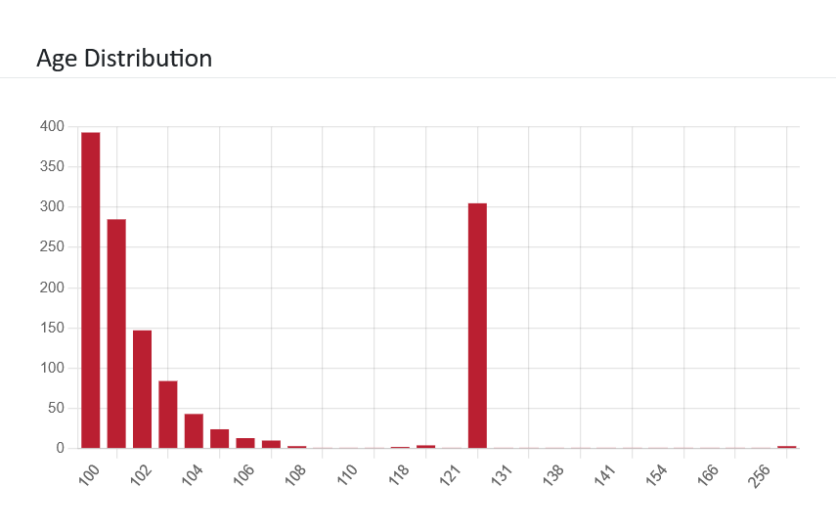
"1/1/1900." As seen on the John Locke Foundation's Vote Tracker, 305 people listed as being 124 years old voted in the 2024 general election. Additionally, three 271-year-olds voted in the same election. The chart below from Vote Tracker shows how many people listed as 100 years old or older voted in 2014. County boards could reach out to affected voters to collect the missing data.
PILF has asked for a meeting with SBE Executive Director Sam Hayes. Hopefully, Hayes will oblige and find out what can be done to address the problems they have discovered.
poll#215