Washington, DC: Part I, Arlington Cemetery |
|
Arlington Cemetery
Washington, District of Columbia is one of the most important cities in the world. It is a young city, even by The United States of America's standards; but considering the legislation and executive decisions that have been made within its limits over the last 70 years, it is inarguably, the most important city in the world over that period. The southern, across from Virginia, side of Washington, D.C. is the most significant: architecturally and in regards to the city planning and design.
That city's design began with George Washington himself. The newly elected (by the electoral college only) president picked the location for the capital to be planned and built across the Potomac River from land he owned had once owned, when he married his wife, Martha Custis. Martha and George would later give the land to Martha's son from a previous marriage, John Parke Custis. John would later bequeath this large, beautiful tract with rolling hills growing monstrous spreading red and white oaks to his son, George Washington Parke Custis.
While the fledgling United States Government, led by the hugely popular Mr. Washington, passed The Residence Act; which allowed the President to appoint three commissioners to oversee the planning and construction of a new capital, the Custis family, led by George Washington Parke Custis, moved toward building what would become the "Custis - Lee Mansion," also know as Arlington House. Sitting upon one of the highest hills of the 1,100 acre tract overlooking the Potomac River, the mansion was intended by George Washington Parke Custis as a living memorial to the First President.
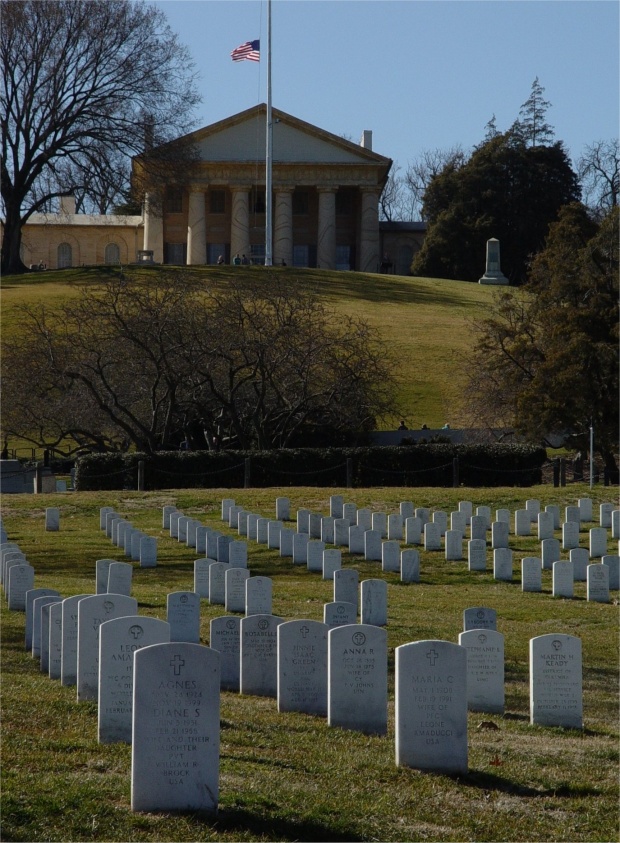
As civil engineer and architect, Peter L'Enfant, appointed in 1791, designed and oversaw the initial construction of this new grandiose capital city on the northern banks of the swirling Potomac. L'Enfant's design was so excellent in many measures, not least of which are the multiple extended sight lines of the streets, malls and promenades. The extended sight lines unintentionally benefit the many vistas atop the rolling hills of Arlington Cemetery, especially from the former Custis - Lee Mansion.
One would be remise if, in discussion of the history of Arlington Cemetery, one did not examine how it came into the hands of the federal government. On June 31, 1831, Mary Randolph Custis married her childhood friend and cousin, Lt. Robert E. Lee. Lieutenant Lee, a West Point Graduate with high honors, would later become Superintendent of West Point after serving with great distinction in the Mexican War, 1846 - 1848. In 1861, after the secession of South Carolina, Colonel Lee was President Abraham Lincoln's first choice to command the entire Union Army. A great patriot to his country, but first a son of Virginia, Colonel Lee respectfully declined. Once Virginia followed South Carolina and seceded from the Union, Robert E. Lee was asked by the Virginia Legislature to command the Army of Northern Virginia in the defense of his state against the presumed invasion by the Army of the Potomac just across the great river. Once the invasion began, the Lees became refugees from their land that was left to the Custis family by George and Martha Washington.
The entire tract was subsequently taken when the county property taxes were not paid in person by the General's wife, while he was leading The Army of Northern Virginia in the Great War between the States or, as it is known in The South, "The War of Northern Aggression." At that time, the Lees had left their ancestral home across the Potomac from the District of Columbia, and could not leave their undisclosed sanctuary in lower Virginia, or run the risk of capture. It was taken by the federal government, effectively for the unpaid taxes (92.07). On January 11, 1864, a federal tax commissioner used this trick, and wrested the taken land from ancestors of "The Father of the United States of America" for 26,800.00 (a fraction of its value. It was later purchased for an additional 150,000.00 in 1883 after the Supreme Court ruled in 1882 that the estate was taken without due process).
The government officials, at that time, offered that the land was purchased for "government use, for war, military, charitable and educational purposes." At that point, with no remedy in the courts available at that time, the federal government wrested this beautiful tract from the Washington - Custis - Lee family, and used it for a Union hospital, a Union Army headquarters, and two forts used for the protection of the Union capital. Eventually during the war, the land was used as a burial ground for Union soldiers.
Once the Great War had ceased, and regardless of which side one's ancestors fought for, Arlington Cemetery becomes hallowed ground for all Americans. Many fallen heroes and other great American citizens, without peer, are interred in the cemetery that celebrates those who have served the people of this great nation. Sadly, and not to belabor the point, Robert E. Lee is not buried here. He is buried beneath Lee Chapel on the grounds of Washington and Lee University in Lexington, Va., where he was President after the war, until his death in 1870. Today, the Custis - Lee Mansion at Arlington serves as a memorial to the great general.
The undulating hills of "Arlington" beneath that memorial that now honors the memory of the Heroic General and his wife, Mary Randolph Custis Lee, also serves as a memorial of interment for the 250,000 American men and women buried there. The primary condition to the right of interment within these hallowed hills on the south side of the Potomac was honorable service in the military of the U.S.A. Later, the requirements were enlarged to include men and women who have honorably served in the federal government of this land. Supreme Court Justices, Washington's Architect Pierre L'Enfant and two Presidents, William Howard Taft and John Fitzgerald Kennedy (JFK also served in the US Navy in World War II) are buried in Arlington.
As the General of the Army of Northern Virginia, Robert E. Lee considered the possible loss of his ancestral home, Arlington; however, as the long war progressed, he obviously was keenly aware of the process engaged to take his land, but as a testament to his sacrifice that is the basis of any true patriot, as exemplified by these wise words in his letter to his wife, "It is better to make up our minds to a general loss. They cannot take away the remembrance of the spot, and the memories of those that to us rendered it sacred. That will remain to us as long as life will last, and that we can preserve."
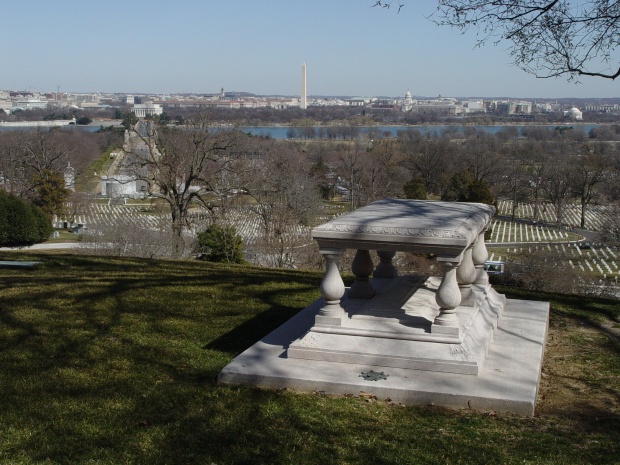
From the crest of the high hill where the Custis - Lee Mansion sits, one can look across the Potomac up the Arlington Memorial Bridge to the Lincoln Memorial. From the Lincoln Memorial, vectored due east is the extended sight line from the Memorial across the Reflecting Pool, to the World War II Memorial, to the Washington Monument (is now and will be for perpetuity, the highest constructed edifice in the District of Columbia), down the entire length of The Mall to the U.S. Capitol. It is quite a view.
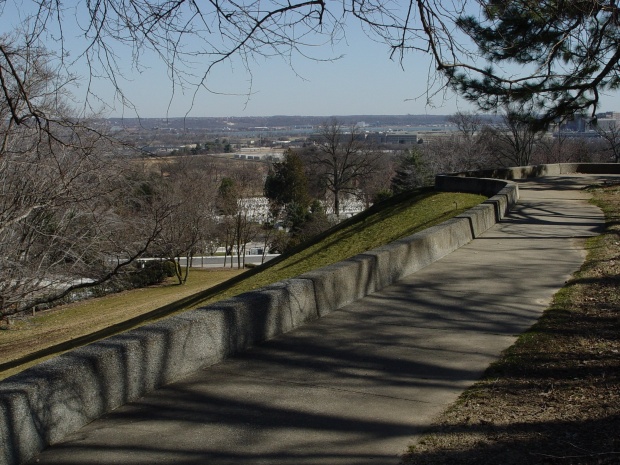
Also from the promontory of that same high hill, where Robert and Mary loved and lived, is the due south view of the one of the world's largest buildings (the largest in footprint), The Pentagon. How fitting can it be to have the building, where wars are planned, and later, from that place waged so near to hallowed grounds, where the heroes of those conflicts are interred. On another note, can you just imagine what must have been the thoughts of visitors of this 1,100 acre memorial on September 11, 2001, when Al Quieda Terrorists flew an American Airliner into the buttressed wall of this colossal building? Yet another dark day in America's history that this stoic nation has, like the phoenix, risen from the ashes of despair to soar another day.
Flash back to early 1995, just after I was elected to my first term as a County Commissioner, I was invited to join the North Carolina delegation of county commissioners on a trip offered by the North Carolina National Guard to the Pentagon, Arlington, and the newly constructed Vietnam War Memorial. We left in an Air National Guard C-130 early that winter morning from Raleigh, NC, and made that short hop to Andrews Air Force Base on the northeast side of Washington, DC. Our first stop, as traveled by bus through the city, was a quick stop at the Viet Nam War Memorial, which set the mood for part of the day - patriotically somber. Our second stop was the Pentagon where we were shown the outlay of this massive building, and ultimately, our hosts revealed to the delegation two of the war rooms, whereby military leaders in the Pentagon can stay in contact (video / audio), with any soldier in the field at any time ... and this was 1995.
The last half of this day trip was spent at Arlington Cemetery, where we were given a prime viewing station at the tomb of the Unknown Soldier. It was a moving display of the changing of the guard that is conducted: at the top of the hour of every day, of every year as long as we are a nation. This is our nation's constant respect for those soldiers, who paid the ultimate sacrifice for our freedom, and now for perpetuity lie in an unknown grave, often in a far away land.
Washington, District of Columbia is one of the most important cities in the world. It is a young city, even by The United States of America's standards; but considering the legislation and executive decisions that have been made within its limits over the last 70 years, it is inarguably, the most important city in the world over that period. The southern, across from Virginia, side of Washington, D.C. is the most significant: architecturally and in regards to the city planning and design.
That city's design began with George Washington himself. The newly elected (by the electoral college only) president picked the location for the capital to be planned and built across the Potomac River from land he owned had once owned, when he married his wife, Martha Custis. Martha and George would later give the land to Martha's son from a previous marriage, John Parke Custis. John would later bequeath this large, beautiful tract with rolling hills growing monstrous spreading red and white oaks to his son, George Washington Parke Custis.
While the fledgling United States Government, led by the hugely popular Mr. Washington, passed The Residence Act; which allowed the President to appoint three commissioners to oversee the planning and construction of a new capital, the Custis family, led by George Washington Parke Custis, moved toward building what would become the "Custis - Lee Mansion," also know as Arlington House. Sitting upon one of the highest hills of the 1,100 acre tract overlooking the Potomac River, the mansion was intended by George Washington Parke Custis as a living memorial to the First President.
As civil engineer and architect, Peter L'Enfant, appointed in 1791, designed and oversaw the initial construction of this new grandiose capital city on the northern banks of the swirling Potomac. L'Enfant's design was so excellent in many measures, not least of which are the multiple extended sight lines of the streets, malls and promenades. The extended sight lines unintentionally benefit the many vistas atop the rolling hills of Arlington Cemetery, especially from the former Custis - Lee Mansion.
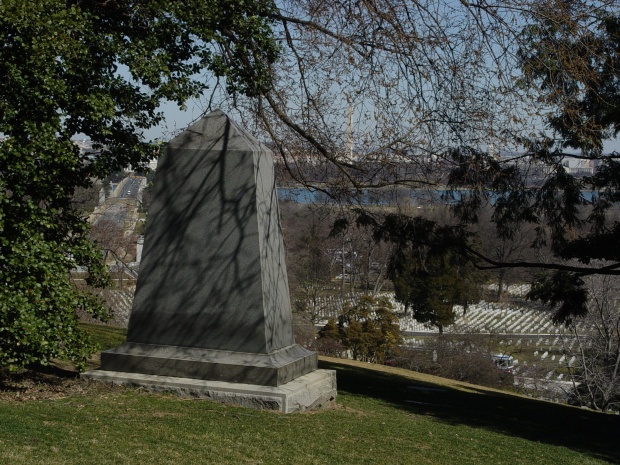
One would be remise if, in discussion of the history of Arlington Cemetery, one did not examine how it came into the hands of the federal government. On June 31, 1831, Mary Randolph Custis married her childhood friend and cousin, Lt. Robert E. Lee. Lieutenant Lee, a West Point Graduate with high honors, would later become Superintendent of West Point after serving with great distinction in the Mexican War, 1846 - 1848. In 1861, after the secession of South Carolina, Colonel Lee was President Abraham Lincoln's first choice to command the entire Union Army. A great patriot to his country, but first a son of Virginia, Colonel Lee respectfully declined. Once Virginia followed South Carolina and seceded from the Union, Robert E. Lee was asked by the Virginia Legislature to command the Army of Northern Virginia in the defense of his state against the presumed invasion by the Army of the Potomac just across the great river. Once the invasion began, the Lees became refugees from their land that was left to the Custis family by George and Martha Washington.
The entire tract was subsequently taken when the county property taxes were not paid in person by the General's wife, while he was leading The Army of Northern Virginia in the Great War between the States or, as it is known in The South, "The War of Northern Aggression." At that time, the Lees had left their ancestral home across the Potomac from the District of Columbia, and could not leave their undisclosed sanctuary in lower Virginia, or run the risk of capture. It was taken by the federal government, effectively for the unpaid taxes (92.07). On January 11, 1864, a federal tax commissioner used this trick, and wrested the taken land from ancestors of "The Father of the United States of America" for 26,800.00 (a fraction of its value. It was later purchased for an additional 150,000.00 in 1883 after the Supreme Court ruled in 1882 that the estate was taken without due process).
The government officials, at that time, offered that the land was purchased for "government use, for war, military, charitable and educational purposes." At that point, with no remedy in the courts available at that time, the federal government wrested this beautiful tract from the Washington - Custis - Lee family, and used it for a Union hospital, a Union Army headquarters, and two forts used for the protection of the Union capital. Eventually during the war, the land was used as a burial ground for Union soldiers.
Once the Great War had ceased, and regardless of which side one's ancestors fought for, Arlington Cemetery becomes hallowed ground for all Americans. Many fallen heroes and other great American citizens, without peer, are interred in the cemetery that celebrates those who have served the people of this great nation. Sadly, and not to belabor the point, Robert E. Lee is not buried here. He is buried beneath Lee Chapel on the grounds of Washington and Lee University in Lexington, Va., where he was President after the war, until his death in 1870. Today, the Custis - Lee Mansion at Arlington serves as a memorial to the great general.
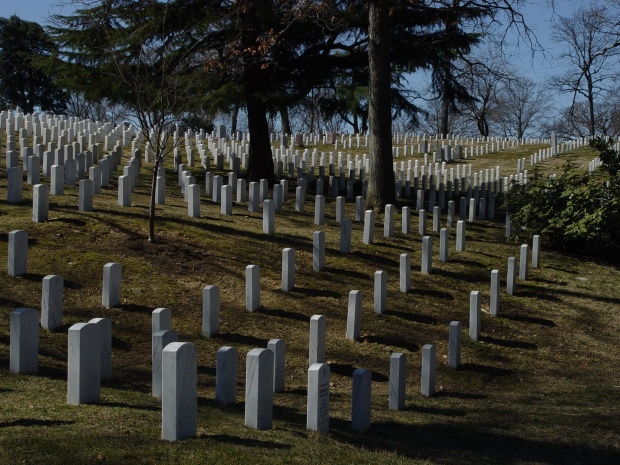
The undulating hills of "Arlington" beneath that memorial that now honors the memory of the Heroic General and his wife, Mary Randolph Custis Lee, also serves as a memorial of interment for the 250,000 American men and women buried there. The primary condition to the right of interment within these hallowed hills on the south side of the Potomac was honorable service in the military of the U.S.A. Later, the requirements were enlarged to include men and women who have honorably served in the federal government of this land. Supreme Court Justices, Washington's Architect Pierre L'Enfant and two Presidents, William Howard Taft and John Fitzgerald Kennedy (JFK also served in the US Navy in World War II) are buried in Arlington.
As the General of the Army of Northern Virginia, Robert E. Lee considered the possible loss of his ancestral home, Arlington; however, as the long war progressed, he obviously was keenly aware of the process engaged to take his land, but as a testament to his sacrifice that is the basis of any true patriot, as exemplified by these wise words in his letter to his wife, "It is better to make up our minds to a general loss. They cannot take away the remembrance of the spot, and the memories of those that to us rendered it sacred. That will remain to us as long as life will last, and that we can preserve."
From the crest of the high hill where the Custis - Lee Mansion sits, one can look across the Potomac up the Arlington Memorial Bridge to the Lincoln Memorial. From the Lincoln Memorial, vectored due east is the extended sight line from the Memorial across the Reflecting Pool, to the World War II Memorial, to the Washington Monument (is now and will be for perpetuity, the highest constructed edifice in the District of Columbia), down the entire length of The Mall to the U.S. Capitol. It is quite a view.
Also from the promontory of that same high hill, where Robert and Mary loved and lived, is the due south view of the one of the world's largest buildings (the largest in footprint), The Pentagon. How fitting can it be to have the building, where wars are planned, and later, from that place waged so near to hallowed grounds, where the heroes of those conflicts are interred. On another note, can you just imagine what must have been the thoughts of visitors of this 1,100 acre memorial on September 11, 2001, when Al Quieda Terrorists flew an American Airliner into the buttressed wall of this colossal building? Yet another dark day in America's history that this stoic nation has, like the phoenix, risen from the ashes of despair to soar another day.
Flash back to early 1995, just after I was elected to my first term as a County Commissioner, I was invited to join the North Carolina delegation of county commissioners on a trip offered by the North Carolina National Guard to the Pentagon, Arlington, and the newly constructed Vietnam War Memorial. We left in an Air National Guard C-130 early that winter morning from Raleigh, NC, and made that short hop to Andrews Air Force Base on the northeast side of Washington, DC. Our first stop, as traveled by bus through the city, was a quick stop at the Viet Nam War Memorial, which set the mood for part of the day - patriotically somber. Our second stop was the Pentagon where we were shown the outlay of this massive building, and ultimately, our hosts revealed to the delegation two of the war rooms, whereby military leaders in the Pentagon can stay in contact (video / audio), with any soldier in the field at any time ... and this was 1995.
The last half of this day trip was spent at Arlington Cemetery, where we were given a prime viewing station at the tomb of the Unknown Soldier. It was a moving display of the changing of the guard that is conducted: at the top of the hour of every day, of every year as long as we are a nation. This is our nation's constant respect for those soldiers, who paid the ultimate sacrifice for our freedom, and now for perpetuity lie in an unknown grave, often in a far away land.
| Once Upon a Time in America | National Parks and other National Places, Living, Travel | National Parks: Part III, The Cape Hatteras Light Station |
{ QR Code for Mobile Phones }