Within seven minutes after the ramps drop, ABLE Company was inert and leaderless. At Boat No. 2, Lieutenant Tidrick took a bullet through the throat as he jumped from the ramp into the water. He staggered onto the sand and flopped down ten feet from Private First Class Leo J. Nash. Nash saw the blood spurting and heard the strangled words gasped by Tidrick: "Advance with the wire cutters!" But it was futile; Nash had no cutters. To give the order, Tidrick had raised himself up on his hands and made himself a target for an instant. And that was all it took. Nash, burrowing into the sand, saw machine gun bullets rip Tidrick from crown to pelvis. From the cliff above, the German gunners were shooting into the survivors as if from a roof top perch.
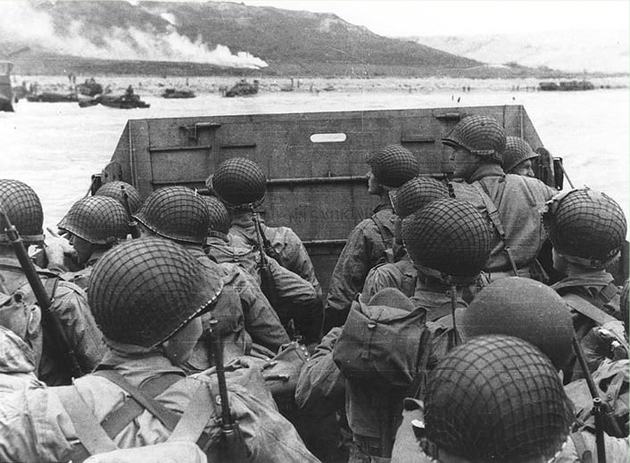 American G.I.'s preparing to land on the Hell that was Omaha Beach: Above.
Captain Taylor N. Fellers and Lieutenant Benjamin R. Kearfoot never made it. Their boat, Boat No. 6 (Landing Craft, Assault, No. 1015), was loaded with thirty men. Exactly what happened to this boat and its human cargo was never to be known. No one saw the craft go down. How each man aboard it met death remains unreported. Half of the drowned bodies were later found along the beach. It is supposed that the others were claimed by the sea.
Along the beach, only one Able Company officer was still alive -- Lieutenant Elijah Nance, who was hit in the heel. By the time he made it to the sand, a second bullet hit him in the belly. By the end of ten minutes, every sergeant was either dead or wounded. To the eyes of such men as Private Howard I. Grosser and Private First Class Gilbert G. Murdock, this clean sweep suggested that the Germans on the high ground had spotted all leaders and concentrated fire their way. Among the men who were still moving in with the tide, rifles, packs, and helmets had already been cast away in the interests of survival.
To the right of where Tidrick's boat was drifting with the tide, its coxswain lay dead next to the shell-shattered wheel. The ramp dropped and in that instant, two machine guns concentrated their fire on the opening. Not a single man was given time to jump. All aboard were cut down where they stand.
By the end of fifteen minutes, Able Company had still not fired a weapon. No orders were being given by anyone. No words were spoken. The few able-bodied survivors moved, or not, as they saw fit.
By the end of one half hour, approximately two thirds of the company was forever gone. There is no precise casualty figure for that moment. There is a casualty figure for the Normandy landing as a whole but no accurate figure for the first hour or the first day. The circumstances precluded it. Whether more Able Company riflemen died from water than from fire is known only to heaven. All earthly evidence indicates such, but it cannot be absolutely proven.
By the end of one hour and forty-five minutes, six survivors from the boat section on the extreme right were able to shake loose and work their way to a shelf a few rods up the cliff. Four fall exhausted from the short climb and made it no farther. They stayed there through the day, seeing no one else from the company. The other two, Privates Jake Shefer and Thomas Lovejoy, joined a group from the Second Ranger Battalion and fought on with the Rangers through the day. Two men. Two rifles. Except for these, this account summarizes Able Company's contribution to the D Day invasion.
BAKER Company was scheduled to land twenty-six minutes after Able and right on top of it. Unfortunately, they were not able to see the disaster which overtook Able until they were almost on top of it. The command boat headed in and as soon as it dropped its ramp, it was immediately hit by a storm of bullet fire.
Captain Ettore Zappacosta jumped from the boat first and while he was in elbow-high tide, he shouted back to his men: "I'm hit." He was bleeding from the hip and shoulder and after staggering for a few minutes, he fell face forward into the wave and the weight of his equipment and soaked pack pinned him to the bottom. Thomas Kenser tried to jump off the boat to get to him but was shot dead while in the air. Lieutenant Tom Dallas of Charley Company, the third man, made it to the edge of the sand where a machine-gun burst blew his head apart.
Private First Class Robert L. Sales, who was lugging Zappacosta's radio, was the fourth man to leave the boat, having waited long enough to see the others die. His boot heel caught on the edge of the ramp and he fell into the tide, losing the radio but saving his life. Every man who tried to follow him was either killed or wounded before reaching dry land. Sales alone was able to reach the beach unhit.
By the end of the day, only forty-seven men made it ashore and to safety. These forty-seven immortals of Omaha, by their dauntless initiative at widely separated points along the beach, saved the landing from total stagnation and disaster. The others were slaughtered wholesale.
Thousands of Americans were spilled onto Omaha Beach. The high ground was won by a handful of men who on that day burned with a flame bright beyond common understanding." [S.L.A. Marshall, "First Wave at Omaha Beach"]
Donald Ceboll, a WWII veteran from Ohio, watched the amphibious landing on Omaha Beach from the deck of a navy landing ship about 2 miles offshore. At 89, he remembers:
"The struggles of those gallant men striving to reach land just ahead..... And of the hapless who failed in their quest and turned the water red. You could see bodies all over. Even though the engines were noisy, you could hear the screams of agony. Oh God, you could hear them," Ceboll remembered.
"You could almost tell by the pitch if they were fatal or not. It was not until near nightfall, when the initial battle was over, that the sights of war caught up with me. My mind didn't want to accept it. I was crying so hard, like a tot that was crying for the comfort and attention of my mother's arms."
After visiting Normandy in 1999, he wrote:
"Peace is so quiet. Dear God, please let it stay that way. Farewell, Omaha."
It is fitting and proper that we as Americans, as well as people all over the world, honor the ultimate sacrifices of American - and British and Canadian - soldiers who were killed wounded during D Day. We should seek to earn their gifts to us by the way we view ourselves as Americans and especially by the way we conduct ourselves as Americans. As Ronald Reagan once said: "Freedom is never more than one generation from extinction. We didn't pass it to our children in the bloodstream. It must be fought for, protected, and handed on for them to do the same, or one day we will spend our sunset years telling our children and our children's children what it was once like in the United States where men were free."
Reagan also said:
"I have seen the rise and fall of Nazi tyranny, the subsequent cold war and the nuclear nightmare that for fifty years haunted the dreams of children everywhere. During that time my generation defeated totalitarianism. As a result, your world is poised for better tomorrows. What will you do on your journey?"













God bless you Diane; you are with Jesus now, and I am sure you are quickly becoming one of his favorites.