Publisher's Note: These posts, by Dr. Terry Stoops, and aptly titled CommonTerry, appears courtesy of our friends at the John Locke Foundation. A full account of Dr. Stoops's posts, or him mentioned as a credible source, are listed here in BCN.
Teacher working conditions: The shocking results!
In February, I published a column titled, "Data Do Not Reflect Claims of Teacher Dissatisfaction," which pointed out that state and national data disagree with those who claim that the teaching profession is increasingly constrained and unhappy. I pointed out that while North Carolina teachers have legitimate and specific concerns about compensation, Common Core state standards, and legislation approved by the N.C. General Assembly, the 2012 Teacher Working Conditions Survey suggested that they are generally content.
Needless to say, I received pushback from teachers, higher education faculty, and members of the mainstream media. Some of the debate, particularly the name-calling part, had nothing to do with the actual data cited in my column. Instead, it relied on personal anecdote and the depiction of a discontented teaching profession cultivated by public school advocacy groups, unions, and the media.
The release of the 2014 Teacher Working Conditions Survey provides another opportunity to assess my argument. First administered in 2002, the biennial survey is a collaborative effort by the N.C. Department of Public Instruction, the North Carolina Association of Educators (NCAE), and The New Teacher Center, a non-profit with offices in six states including North Carolina. In 2014, 88.6 percent of the state's educators responded, a slight increase over the 2012 response rate of 86.2 percent.
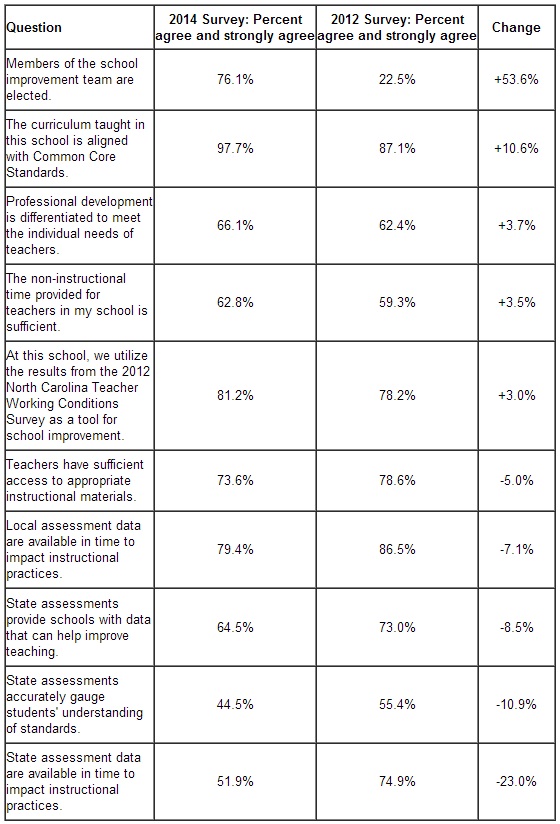
Overall, there were few notable changes in the responses provided in 2012 and 2014 with one exception -- teachers have less trust in the state testing program than they did two years ago. Only 52 percent of teachers agreed that state assessment data are available in time to impact instructional practices, a 23 percent decline from two years earlier. Even more startling is that only 45 percent of teachers believe that state assessments accurately gauge students' understanding of standards, which is an 11 percent drop. Finally, about two-thirds agree that state assessments provide schools with data that can help improve teaching, compared to 73 percent who agreed in 2012.
According to the N.C. Teacher Working Conditions website, the preliminary findings for the 2014 Survey will be presented at the June State Board of Education meeting. Will members of the State Board of Education confront Superintendent of Public Instruction June Atkinson about teachers' loss of faith in state tests, a program that is overseen by her staff? I'll bring the popcorn.
Otherwise, lawmakers should also note that fewer teachers report that they have sufficient access to appropriate instructional materials. While the percentage of educators who agree that they have access to instructional materials remains relatively high at 74 percent, our state needs to do a better job of funding instructional materials such as textbooks. Governor McCrory's proposed budget recommended doubling textbook funds for the 2014-15 school year.
The fact that there were few significant changes is noteworthy. It suggests that Republican policies and laws did not disrupt working conditions that most teachers say are favorable. Indeed, 85 percent of respondents agreed that their school is a good place to work and learn, a slight increase from 2012. That said, the limited scope of the survey does not allow us to draw conclusions about teachers' attitudes on specific issues, such as Common Core or performance pay.
Facts and Stats
N.C. Teacher Working Conditions Survey: Ten largest changes between 2012 and 2014
 Acronym of the Week
NC TWC -- North Carolina Teacher Working Conditions
Quote of the Week
"Research from around the country shows that teaching conditions are positively associated with improved student achievement and teacher retention. The NC TWC Survey results will provide educators with data, tools and direct support to facilitate school improvement." - North Carolina Teacher Working Conditions homepage
Click here for the Education Update archive.