Two major cases that could reshape the U.S. government | Eastern NC Now
SCOTUS has a chance to rule in out-of-control bureacrats.

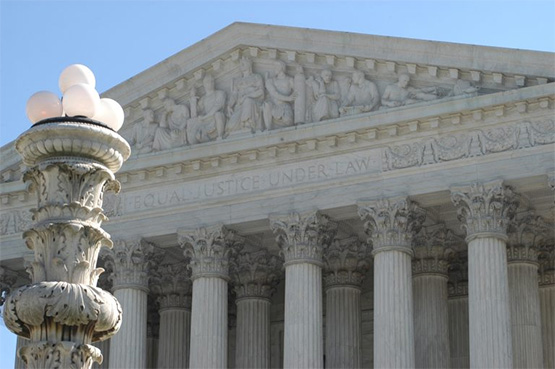
The U.S. Supreme Court has decided to hear a couple of cases in its current term, which could have a significant impact on the power and authority of the Executive Branch. A constitutional expert believes that this could bring about a change in how administrations govern.
The decisions made in these cases could considerably alter the way federal agencies interpret the laws passed by Congress. This could lead to a significant reduction in their ability to issue rules with the binding effect of legislation. Thomas M. Boyd, a former US assistant attorney general who served under President Ronald Reagan, has highlighted the potential impact of these cases.
The court’s rulings could put an end to a constitutional revolution that has lasted for four decades since Reagan’s administration.
According to a column by Boyd this month, Justice John Paul Stephens’ opinion in the Chevron U.S.A. v. National Resources Defense Council case in 1984, midway through Reagan’s two terms, was the beginning of what legal scholar Gary Lawson would later describe as “nothing less than a bloodless constitutional revolution.”
The ruling fundamentally altered the way federal agencies could interpret laws they considered to be “ambiguous.” Following Stephens’ decision, subsequent presidential administrations utilized it to enact policies that effectively functioned as laws, often deviating from the exact wording of the legislation passed by Congress, Boyd pointed out.
“At long last, on Wednesday, the Supreme Court will hear two cases that may signal the beginning of the end to that revolution,” Boyd’s New York Post column noted.
Boyd noted that Article I of the Constitution says explicitly, “All legislative power herein granted shall be vested in a Congress of the United States” — not federal regulatory agencies.
However, he adds, Justice Stephens’ opinion found that “agenc[ies] may . . . properly rely upon the incumbent administration’s views of wise policy” in “reasonably” defining statutory ambiguities.
In simpler terms, Stephens argued that the Executive Branch had the power to determine specific interpretations of laws enacted by the Legislative Branch.
That, Boyd added, was at the center of the Chevron decision and became known as the “Chevron defense, leading President Ronald Reagan’s White House counsel, Peter Wallison, to describe it as ‘the single most important reason the administrative state has continued to grow out of control.'”
Boyd notes: “Forty years of regulatory and judicial tumult have ensued, finally crescendoing to a point that has compelled the Supreme Court to intervene. Loper Bright Enterprises v. Raimondo, from the District of Columbia Circuit, and Relentless v. Department of Commerce, from the First Circuit, are now before the court.
Both are companies that fish for herring in New England and are family-owned and operated, and both are subject to the Magnuson-Stevens Act, which governs fishery management in federal waters. The act allowed the National Marine Fisheries Service to require herring boats, relatively small vessels that normally carry only five to six people, to also carry federal monitors to enforce its regulations.
However, it gets even worse.
The former Reagan assistant attorney general mentioned that the agency, without explicit statutory authorization, proceeded to require Loper Bright and Relentless to bear the expenses for the salaries of these monitors. The NMFS estimated these costs at $710 per day, at times exceeding the income generated from a day’s fishing.
Both federal circuit courts ruled that statutory silence on the matter was an “ambiguity” that required the application of the Chevron deference.
But in accepting the cases, the justices posed a two-part question to be answered and settled: “Whether the Court should overrule Chevron or at least clarify that statutory silence concerning controversial powers expressly but narrowly granted elsewhere in the statute does not constitute an ambiguity requiring deference to the agency.”
Boyd noted that some of the current justices, the constitutional originalists, have already indicated how they are likely to rule.
Several have indicated suspicion in allowing federal agencies—and, by definition, the Executive Branch in general—to have too much leeway in the interpretation of laws, giving them nearly limitless power in governing, Boyd noted.

 |
financial questions lead to removal
Published: Friday, October 16th, 2026 @ 7:51 am
By: John Steed
|
 |
Democrats want to block efforts to find foreign citizens on voter rolls
Published: Thursday, October 15th, 2026 @ 3:12 pm
By: John Steed
|
 |
green energy is expensive energy
Published: Thursday, October 15th, 2026 @ 1:06 pm
By: John Steed
|
 |
illegal alien "asylum seeker" migrants are a crime wave on both sides of the Atlantic
Published: Thursday, October 15th, 2026 @ 12:49 pm
By: John Steed
|
 |
most industrialized countries have citizenship based on nationality
Published: Thursday, October 15th, 2026 @ 10:42 am
By: John Steed
|
 |
he seems extremely sensitive to such questions
Published: Wednesday, October 14th, 2026 @ 3:05 pm
By: John Steed
|

 |
Most Republicans stand for gun rights
Published: Tuesday, October 13th, 2026 @ 9:12 pm
By: John Steed
|
 |
a real prize of a candidate
Published: Tuesday, October 13th, 2026 @ 8:13 pm
By: John Steed
|
 |
No quorum, no chair...no results.
|
 |
"They don’t want you to do is dig into their 'reporting' for bias and conflicts of interest."
Published: Tuesday, October 13th, 2026 @ 6:27 pm
By: Daily Wire
|
 |
socialism is taking over the Democrat Party
Published: Tuesday, October 13th, 2026 @ 3:58 pm
By: John Steed
|
 |
the far left is pushing that cancelling of Columbus
Published: Tuesday, October 13th, 2026 @ 3:50 pm
By: John Steed
|

 |
Only one proven conservative is running...Stan Deatherage.
|