In our view; the Racial Justice Act is absurd | Eastern NC Now

The General Assembly will next week debate whether to override Gov. Bev. Perdue's veto of the repeal of the Racial Justice Act (RJA).

ENCNow
    Publisher's Note: This article originally appeared in the Beaufort Observer.

    The General Assembly will next week debate whether to override Gov. Bev. Perdue's veto of the repeal of the Racial Justice Act (RJA). It is unlikely the opponents of the RJA will muster enough votes to override. Most observers then predict that capital punishment will be dead, no pun intended unless and until something further happens.

    Much of the debate now centers on the issue of whether the provision that death sentences will become "life in prison without parole." The law says this. But the problem is that the courts have recently taken a different slant, causing serious legal questions to be raised about whether under the existing law at the time the crime was committed make it possible for convicts to eligible for parole regardless of what the RJA says. This is true because the law that is applicable to any particular convict is the one that was on the books at the time the crime was committed, not subsequent act. It will take years for that debate to work itself out in the courts.

    Proponents of the RJA say "not to worry." That is the position Gov. Perdue is taking. In the meantime most of the prisoners on death row have appealed their sentences under the RJA and no one really knows what the final outcome of those appeals will be.
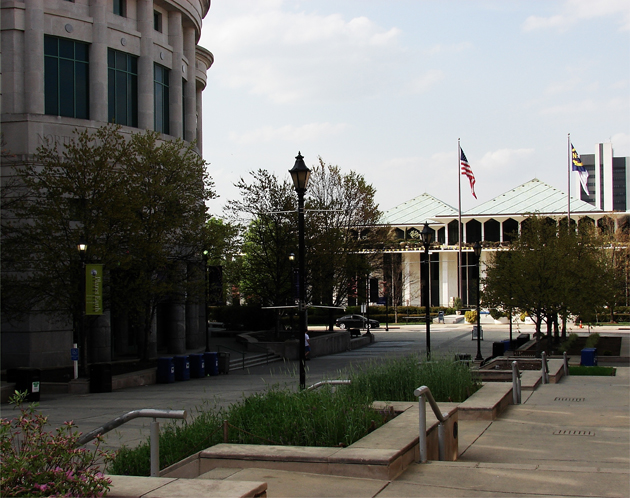
North Carolina General Assembly     photo by Stan Deatherage

    One of the major questions is what kind of evidence will be determined to be conclusive in deciding whether "racial prejudice" was a factor in a capital prosecution, conviction and sentence. The act allows statistical evidence to be used in determined those questions, but it is vague on how the statistical procedures will be used. What level of correlation is sufficient? What data will be used. What standards will be applied to the data interpretation? What variables will be included? For example, how do you measure the impact of mitigating and aggravating variables when those when those factors are not statistically weighted. One aggravating factors can be indicative of a particularly heinous crime while in another case the type of aggravating factor may be much less heinous but there may be several different aggravating factors that were found. Does one convict get his/her sentence reduced and the other not? There are any number of other such questions that can be raised.

    The most serious question, it seems to us, is that if racial discrimination was extant in a conviction should a person even be in prison unless they received a fair trial? It would seem that if, via statistics or otherwise, there is serious doubt that a person got a fair trial that they would receive a new trial.

    The RJA is bad public policy. It is a sneaky way of abolishing the death penalty. It was done that way because a bill to outlaw capital punishment would have never passed because weak legislators would have been unwilling to face the voters after having voted against capital punishment. But this way they can, as did Gov. Perdue, argue that they didn't vote against capital punishment but rather than they voted for eliminating racial discrimination. And we find that to be the most despicable part of this entire debacle. We believe the question of whether North Carolina eliminates capital punishment should be put to a vote of the people as a constitutional amendment.

    We think Second Judicial District Attorney Seth Edwards hit the nail squarely on the head when he said:

    RJA in its current form is simply an end around to abolish the death penalty in nc. The RJA is having unintended consequences such as allowing a white defendant who killed a white victim to have his death sentence converted to life by claiming racial discrimination in some corner of North Carolina. The prosecutors simply believe a defendant must be required to show it in HIS particular case. We are for racial justice for all of North Carolina including crime victims.

    Life without parole means just that today. But it didn't exist prior to 1998. Back then there was Life, which meant parole eligible after 20 years. This is why we are not convinced that a person who gets relief under the RJA and whose crime was pre 1998 will remain in prison the rest of his life.

    The absurdity of the RJA can be seen in looking at other variables that have disparities from the general population. Gender is an example. Education is another. Income is yet another. And we suspect a number of other variables could be determined to have a correlation to a capital sentence. For example, we suspect a strong negative correlation would be found for Eagle Scouts. Does the fact that almost none of the convicts sentenced to death were Eagle Scouts prove that Eagle Scouts get more favorable treatment in the courts? Of course not. But that is the same idea upon which the RJA is based. It is just as absurd, as it is now written.

    A good report on this issue can be read by clicking here for a recent article in the News & Observer by Craig Jarvis.
Go Back

HbAD0

Latest State and Federal

Tax Day is a week away, and the reports are in: North Carolinians are winning big with record-setting tax returns thanks to President Trump and Republicans' Working Families Tax Cuts.
“It is a trust fund, a piece of the American economy for every child that they will be able to take out when they are 18.”
For most of her life, Zofia Cheeseman built her life and schedule around being a gymnast until a health scare forced her to look at her life off the mat.
"We could very well end up having a friendly takeover of Cuba."

HbAD1

You can't make this up. If you turned this script into Hollywood, they'd say it's too on the nose.
"Alaska native" firms, most often in Virginia, were paid $45 billion in Pentagon contracts thanks to DEI law.
Small cities rarely make headlines. Their struggles - fiscal mismanagement, leadership vacuums, the slow erosion of public trust - play out in school gymnasiums and wood-paneled council chambers, witnessed by a handful of residents and largely ignored by the world outside.
"Go that way and get down ... there has been a shooting ... there are people dead over here."
Former provost Chris Clemens has dropped his open meetings and public records lawsuit against the University of North Carolina at Chapel Hill.

HbAD2

How the Minnesota Senate race became a purity test for the far Left

HbAD3


Back to Top