Superior Court Judge Dismisses Latest Legal Challenge Against CON | Eastern NC Now

A Durham County Superior Court judge has dismissed a New Bern eye surgeon’s lawsuit challenging the state’s certificate-of-need law.

ENCNow
Publisher's Note: This post appears here courtesy of the Carolina Journal. The author of this post is CJ Staff.

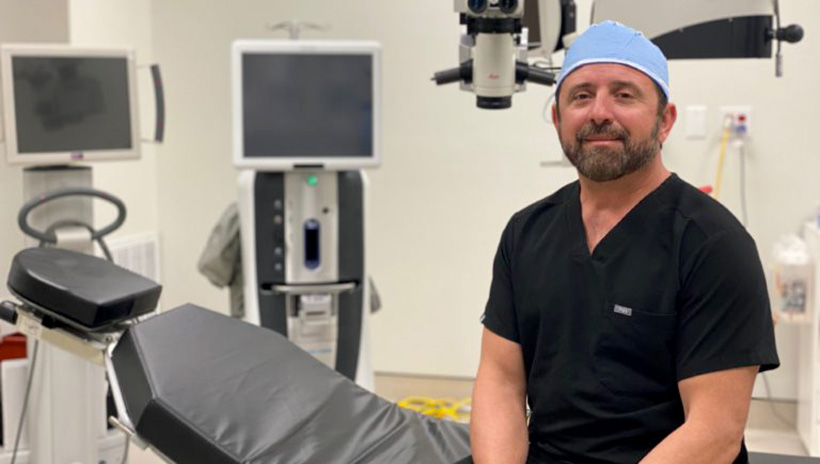
Dr. Jay Singleton can't perform a five-minute cataract surgery without admitting his patients to a hospital. | Photo: Contributed

    A Durham County Superior Court judge has dismissed a New Bern eye surgeon's lawsuit challenging the state's certificate-of-need law.

    Judge Michael O'Foghludha heard roughly two hours of arguments Thursday, June 3, before agreeing with state lawyers' motion to kill the suit. The ruling can be appealed.

    Dr. Jay Singleton argues that North Carolina's CON law is unconstitutional when applied to him.

    Singleton has performed more than 30,000 eye surgeries. State law allows him to perform outpatient procedures like cataract surgeries at his New Bern-based Singleton Vision Center on an "incidental, limited basis." But state regulators force the doctor to perform most of those same procedures at a hospital.

    Requiring patients to use a hospital increases cost and decreases convenience, Singleton argues. That's despite the fact that performing the procedures at Singleton Vision Center is just as safe as the hospital option, according to Singleton's argument.

    If appellate courts eventually allow the case to proceed, Singleton hopes to have CON restrictions struck down for his business. The John Locke Foundation has filed a friend-of-the-court brief supporting Singleton's case.

    Singleton's case represents CON opponents' "third bite at the apple" in challenging the law. That's according to Derek Hunter, the assistant state attorney general representing state government defendants.

    The state's appellate courts upheld the CON law as constitutional as recently as 2010, in the case of Hope-A Women's Cancer Ctr., P.A. v. State. Just last year, Hunter argued, courts dismissed an almost-identical challenge to CON from a Winston-Salem surgeon, Dr. Gajendra Singh.

    Singleton's lawyer countered that the state argues that Singleton "needs to go begging" to government regulators, spending hundreds of thousands of dollars to win the certificate of need. That certificate would grant him state government permission to perform the additional procedures he wants to offer customers at Singleton Vision Center.

    "He doesn't want a CON — he doesn't want to be a monopolist," said Renee Flaherty, the Institute for Justice attorney representing Singleton.

    O'Foghludha rejected the state's argument that Singleton's case should be tossed because the doctor never applied to secure a CON. But the judge agreed with state lawyers that the CON law should be upheld based on a legal test known as "rational basis."

    Under that test, a law is constitutional if legislators could have had any "rational basis" for approving it. That's a much easier standard for the government to meet than "strict scrutiny." That's an alternative legal standard courts can adopt when a plaintiff argues that his fundamental constitutional rights have been violated.
Go Back


Leave a Guest Comment

Your Name or Alias
Your Email Address ( your email address will not be published )
Enter Your Comment ( text only please )


What happens when you defund the police Carolina Journal, Editorials, Op-Ed & Politics N.C. House Votes to Cut off Expanded $300-a-Week Federal Unemployment Benefits


HbAD0

Latest Op-Ed & Politics

Beaufort County residents deserve lower taxes and should demand them from government.
Cheryl Hines. Dennis Quaid. Nicki Minaj. All became associated with the Trump administration. What happened next?

HbAD1

"Pay no attention to the folks behind the curtain" was their preference but things are beginning to come to light.
Understanding how parties work is important for making informed decisions regarding elected officials.
Two years ago, new media brought President Trump back to the White House. What happened?
Victims’ advocates, prosecutors, law enforcement officials, and families impacted by violent crime gathered Tuesday at the North Carolina State Archives building in Raleigh to recognize National Crime Victims’ Rights Week and honor those affected by crime across North Carolina.

HbAD2


HbAD3


Back to Top