Publisher's note: The author of this post, Doug Boyd, is a contributor to ECU News Services.
ECU takes administrative lead for five campuses in Coastal Studies Institute
An agreement among five universities has confirmed the multi-institutional mission of the University of North Carolina Coastal Studies Institute and established East Carolina University as the administrative campus of the state university system's program to better understand the North Carolina coast.
In addition to ECU, member institutions of the CSI are Elizabeth City State University, N.C. State University, UNC-Chapel Hill and UNC-Wilmington.
Located in Wanchese, the institute was founded in 2003 as a result of recommendations in the UNC Board of Governors' Marine Science Plan to expand the research and academic footprint of the UNC system to all three geographic coastal locations of the state. The memorandum of understanding was signed in April by the chancellors of the constituent universities and Tom Ross, president of the UNC system.
"We're excited to work with ECU in an innovative, multi-campus governance model," said Nancy White, director of the institute.
"We feel like there will be great opportunities to work on this multi-campus model with ECU taking a leadership role."
Nancy White, director of the Coastal Studies Institute.
The institute is an effective partnership for studying coastal development and natural resources as well as community outreach and communication with stakeholders about the issues facing the coast. It calls upon the strengths of member institutions to address important issues facing North Carolina's coastal zone.
White, also an associate professor of biology at ECU, will transition to the title of executive director and report to ECU Provost Ron Mitchelson. She previously reported to Ross.
"This is a piece of our larger emphasis on coastal science and policy," Mitchelson said of ECU's stronger relationship with the institute.
"We are excited about its multi-institutional nature and our access to the coast and colleagues at other schools."
The coastal emphasis is part of ECU's new strategic plan, unveiled earlier this year. The other parts being worked on are the establishment of a School of the Coast at ECU and a joint doctoral program in coastal and marine sciences with UNC-Wilmington.
With ECU being the administrative home of the institute, Chancellor Steve Ballard will appoint seven to nine members to the board of directors in consultation with the board.
The institute's home on Roanoke Island opened in 2013. It is an 83,791-square-foot environmentally sustainable facility built on land surrounded by approximately 240 acres of marsh. Its $32.6 million cost was paid for by state appropriations. ECU was responsible for design and construction oversight and maintains the facility.
Other ECU faculty involved with the institute are economics professor Andy Keeler, Nathan Richards, associate professor of maritime history; and geological science professors Reide Corbett and J.P. Walsh. Faculty members from North Carolina State University and UNC-Chapel Hill are also in residence at the site.
Research under way at the institute includes innovative approaches to capturing energy from the ocean, methods to restore oyster reefs, the ecological effects of stormwater runoff and sustainable designs for coastal communities.
Local communities are also involved. The institute grew out of the Dare County Task Force on Higher Education, formed in the mid-1990s. It was preceded by other successful university-community partnerships, such as those that founded the North Carolina aquariums in the 1980s.
Rolf Blizzard, vice president of Turnpike Properties, a real estate development firm based in Winston-Salem, chairs the institute board of directors.
More information about the institute is online at
http://csi.northcarolina.edu.
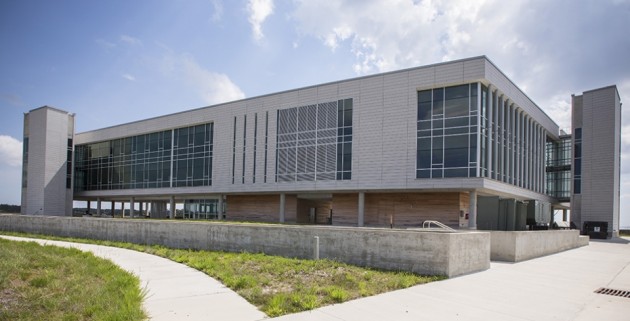
The Coastal Studies Institute facility at Wanchese.
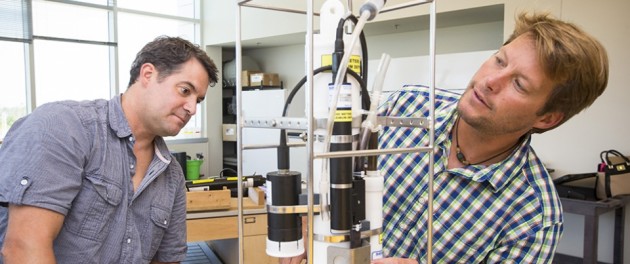
ECU professors J.P. Walsh, left, and Reide Corbett work in a research lab at the Coastal Studies Institute. (Photography by Cliff Hollis)