Assistant Professor Uses Satellite Imagery to Study Coastal Systems | Eastern NC Now

What does West Africa’s coastline have in common with eastern North Carolina’s Outer Banks?

ENCNow
Publisher's note: The author of this post, Matt Smith, is a contributor to ECU News Services.

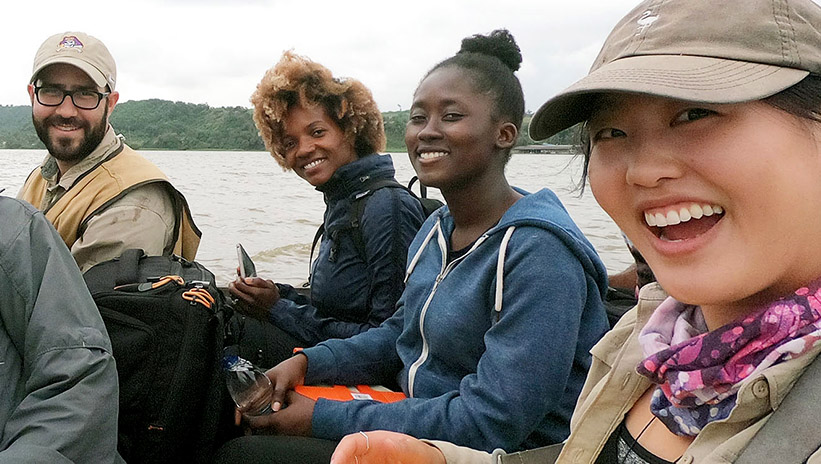
ECU Assistant Professor David Lagomasino, center, travels on a boat with students and research colleages in West Africa. Lagomasino visited the region in August to study the coastal ecosystem which resembles North Carolina’s coast. | Photos: David Lagomasino

    What does West Africa's coastline have in common with eastern North Carolina's Outer Banks?

    A lot more than you might think, says East Carolina University assistant professor David Lagomasino.

    Lagomasino, who began his first semester in ECU's Department of Coastal Studies in August, visited West Africa last month as part of a research study funded by NASA. The 2007 ECU graduate uses satellite images and remote airborne sensors to study coastal ecosystems around the world, including the Outer Banks and tropical coastlines like those in West Africa and India.

    What he hopes to understand is how and why coastline ecosystems are affected by human interaction, including the effects of commodity development, tourism growth and the loss of ecosystem space due to natural and man-made environmental factors. The three-year project entered its second year this summer with Lagomasino traveling across the Atlantic Ocean to the Ivory Coast.

    "A lot of people don't know it, but West Africa's coastal ecosystem is very similar to eastern North Carolina," Lagomasino said. "They have barrier islands, large lagoons and a lot of people and tourism along the coastline. They're dealing with a lot of the same problems we're dealing with along our coastline, including erosion, saltwater intrusion and loss of land due to development. I want to explore how international regions are handling these challenges so that we can possibly bring those interventions back to North Carolina."

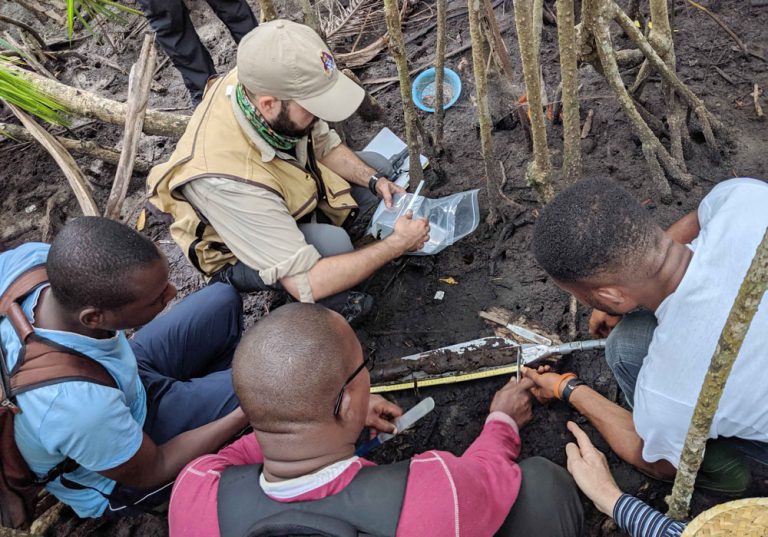
Lagomasino and a team of researchers gather soil samples in a mangrove forest. The samples will be tested to determine how much carbon the soil is storing.
    In the past, Lagomasino's research at NASA's Goddard Space Flight Center used satellite images to explore marshes, beach dunes, maritime forests and inner banks agriculture. Making the trip to West Africa, however, allowed him to see the effects of an ever-changing coastline in person, giving him a different perspective to bring back to the United States.

    "We see the day-to-day transformations in our neighborhoods and cities, but we don't always see the large scale changes to our environment," Lagomasino said. "My work uses satellite data to show visual change on a grand scale. When you see how our forests have been depleted or how much beach we've lost due to erosion, it puts things into a different perspective."

    Lagomasino's West African research study specifically examines maritime environments that store large amounts of carbon, known as "blue carbon" ecosystems. These ecosystems give the region the most "bang for its buck" in carbon storage, keeping carbon dioxide out of the atmosphere and other nutrients, like nitrogen and phosphorus, from rising to dangerous levels in water systems.

    "A lot of the change we see in these ecosystems tends to be human-driven," he said. "Forests are being converted into commodity-type land uses like shrimp and rice farms in Indonesia; barrier islands are being renourished on the beach side, but not the inlet side, which can have the unintended consequence of leaving these regions more susceptible to high tides and storm surge. There can be dramatic effects on our ecosystem at a global level when we do not study the effects and results of the changes we make on our coastlines."

    What excites Lagomasino the most about joining the Department of Coastal Studies is the interdisciplinary nature of ECU's Outer Banks Campus and bringing students into his research.

    "The new department drew me back to ECU," Lagomasino said. "The interdisciplinary approach of putting researchers with multiple backgrounds together to address coastal issues is exciting. I can work alongside an economist one day and an anthropologist the next. There are a bunch of different ways to solve the same problem, so working with a diverse team here, as well as international researchers like those in West Africa, gives our team a great chance to get better answers to building a more resilient coastline.

    "I'm also really looking forward to working with students. I can't wait to provide a hands-on experience. It won't just be studying, but actually getting them out in the field, collecting and analyzing data, and communicating that data to the public. We're ready to do some innovative research here in the Outer Banks."

    Learn more about Lagomasino and ECU's Department of Coastal Studies by visiting the department online.
Go Back

HbAD0

Latest Neighboring Counties

A North Carolina State Senate race is heading for a recount after the two pro-Trump Republicans come down to a two vote margin.
This is simply a failure of will, and we are here to help impose that will today, so that to me is the simple punchline," said State Treasurer Brad Briner. "I appreciate the leaders of Rocky Mount being here, but we need to get to a place where there is the will to fix a very, very serious problem.”
A federal judge will not issue an injunction blocking local Watauga County election districts created by the Republican-led North Carolina General Assembly.
The FBI has captured Alejandro “Alex” Rosales Castillo, who is on the 10 Most Wanted Fugitive list and wanted in connection with a 2016 murder in Charlotte.
A major redevelopment project planned in Morehead City has been scrapped following strong public opposition over the use of eminent domain.
In the coming months, the North Carolina Supreme Court will decide whether a class-action lawsuit can move forward against Raleigh over water and sewer impact fees.
Former congressman Wiley Nickel made his candidacy for the office of Wake County district attorney official this week, with his Tuesday announcement.
Groups representing North Carolina's travel and tourism industry support a lawsuit against Currituck County at the North Carolina Supreme Court.
Plaintiffs in a $16 million class-action lawsuit against Raleigh challenged the city's legal tactics in a new state Supreme Court filing.

HbAD1


Back to Top