Another Look at NC Election Results | Eastern NC Now
Elections can be viewed at many different angles, from analyzing voter turnout to interpreting vote totals.

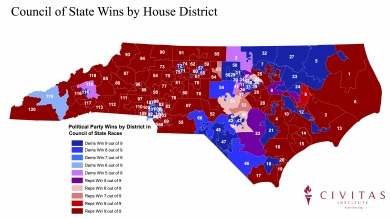 Out of 120 state House districts, 64 were won by all nine Republican Council of State candidates and 35 House districts were won by all nine Democratic candidates, leaving 21 districts with split votes. Of these, in 11 more than half of the Republican candidates were the top vote-getters, while in 10 Democrats received the most votes.
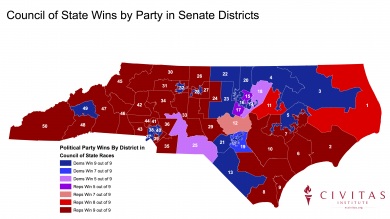 Comparing the maps on this page with the CPI maps and then looking at Civitas Vote Tracker and the voter registration database in Carolina Transparency helps develop a more comprehensive picture of what really happened in the 2012 General Election. We invite you to take a look and decide for yourself.

 |
Conservative club next meeting is Thursday October 15 at 6:00 PM at King Chichen Restaurant.
Published: Monday, October 5th, 2026 @ 9:18 am
By: ENC NOW
|
 |
On Thursday September 17 at 6:00 PM we will have mayor Robert Burns, candidate for governor, to speak and take questions for one hour.
Published: Monday, September 14th, 2026 @ 1:02 pm
By: Hood Richardson
|
 |
Republicans have consistently backed the blue and new data shows President Trump's strong leadership has led to the fastest decline in violent crime in modern American history.
Published: Tuesday, August 4th, 2026 @ 12:14 pm
By: ENC NOW
|
 |
Sanctuary county for the unborn resolution to be presented by Stan Deatherage at tonight’s (Monday August 3) Beaufort County commissioner meeting.
Published: Tuesday, August 4th, 2026 @ 8:26 am
By: Hood Richardson
|
 |
Queen Garris has made a post on the Beaufort County GOP site that you should read. It is disloyal to conservative candiates key in the following: https://www.Facebook.Com/beaufortcountygop
Published: Tuesday, July 28th, 2026 @ 9:03 am
By: Hood Richardson
|
 |
(RALEIGH) Today, Governor Stein announced he has signed one bill into law.
Published: Wednesday, May 13th, 2026 @ 11:07 am
By: Kevin Smith
|

|
If you are covering Roy Cooper in Greensboro today, please consider the following statement from the Republican National Committee:
Published: Wednesday, May 6th, 2026 @ 11:14 am
By: Kevin Smith
|
 |
It has been several days since a deranged left-wing lunatic attempted to assassinate President Trump and other members of his administration and yet Roy Cooper is STILL silent out of fear of alienating his base, who is perfectly okay with violence.
Published: Thursday, April 30th, 2026 @ 11:00 am
By: ENC NOW
|
 |
Tax Day is a week away, and the reports are in: North Carolinians are winning big with record-setting tax returns thanks to President Trump and Republicans' Working Families Tax Cuts.
Published: Monday, April 13th, 2026 @ 10:21 am
By: ENC NOW
|
 |
Change in schedule for executive committee meeting. Meeting Thursday April 9 is cancelled.
Published: Friday, April 10th, 2026 @ 9:59 am
By: Hood Richardson
|
 |
After years in the limelight for his combative style both with Democrats and his fellow Republicans, Crenshaw's future now unsure.
Published: Tuesday, April 7th, 2026 @ 11:21 am
By: Daily Wire
|
 |
If he wins in November, Teixeira will be the all-time Congressional home run leader.
Published: Monday, April 6th, 2026 @ 4:21 am
By: Daily Wire
|

 |
The county boards of elections in Guilford and Rockingham counties on Tuesday morning will begin a partial hand recount of ballots in randomly selected precincts in the N.C. Senate District 26 contest between candidates Phil Berger and Sam Page.
Published: Sunday, April 5th, 2026 @ 6:46 pm
By: ENC NOW
|