Testing Time | Eastern NC Now

Saliva testing will begin in February for ECU students, faculty and staff

ENCNow
Publisher's Note: This post appears here courtesy of ECU News Services. The author of this post is Crystal Baity.

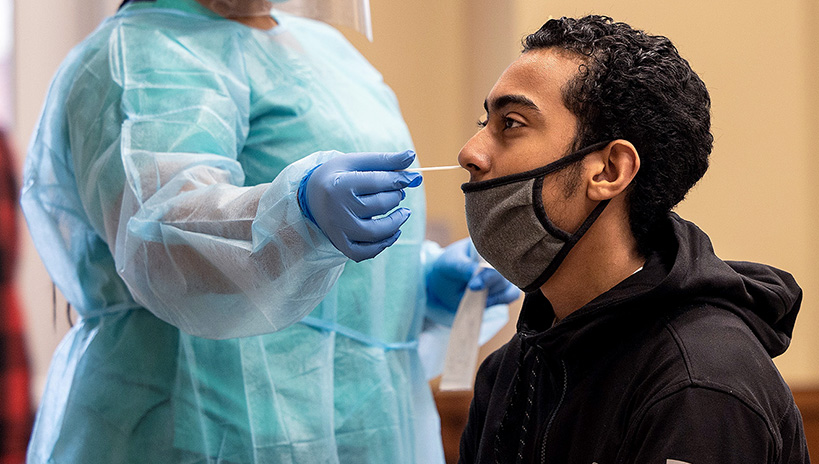
ECU student Alex Stanley gets a COVID-19 test in Ballard Residence Hall during early drop-off on Jan. 8. | Photos: Rhett Butler

    With the spring semester underway, East Carolina University will offer another COVID-19 test option for students, faculty and staff.

    Saliva testing will begin later in February as part of a mass surveillance effort for people who do not have symptoms, have not been exposed to COVID-19 and have not tested positive in the past.

    "Saliva testing is easier and a more comfortable collection method," said Dr. LaNika Wright, director of Student Health Services (SHS).

    Because saliva testing involves spitting in a tube, rather than a nasopharyngeal or nose swab, more people may agree to be tested and checked more often, helping to reduce cases or potential clusters.

    Results are expected in 24 hours, and the test will be offered for free. Any positive saliva tests should be confirmed with a clinical test.

    As part of Return to Pirate Nation's on-campus testing plan for spring, students had to show a negative PCR test before moving into residence halls.

    Between Feb. 1-3, SHS will be testing all on-campus students — about 1,900 — again. Students received an email from Campus Living with their assigned time for the free test, which will be done in the Main Campus Student Center. Testing is required for every on-campus resident unless they are part of another campus testing program (such as athletes) or have tested positive in the past 90 days.

    Regular testing will continue for on-campus students throughout the spring semester.

    All students should be tested, especially those who will be on campus for classes or other activities.

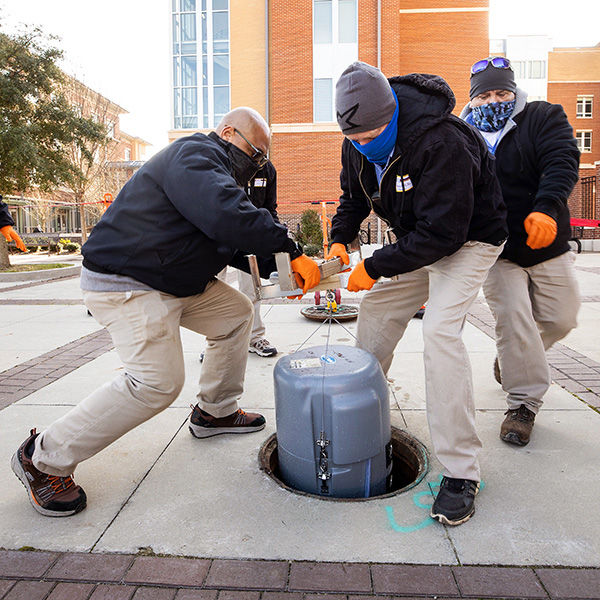
    In addition to the planned saliva testing, another ECU surveillance effort geared at reducing transmission and outbreaks is already underway. Wastewater testing from residence halls began after students moved in for the start of spring semester classes on Jan. 19.

    Virus is shed in feces and can be detected before anyone has symptoms or is asymptomatic. Several departments across campus are collaborating to collect, process and analyze wastewater samples three times a week. Follow-up diagnostic testing will be conducted with students if any samples come back positive.

ECU facilities services staff members remove a COVID-19 wastewater testing unit outside Tyler Residence Hall on College Hill.

    To determine whether someone is infected with SARS-CoV-2, the virus that causes COVID-19, there are two commonly available clinical tests:

  • PCR (or RT-PCR) tests are used to detect genetic material of the virus. These are used to detect current active infection and are highly accurate when collected properly. Results are available in about 24 hours. "This is a very accurate test with some false negatives but very few false positives. If it says you have COVID-19, you've got it," said Dr. Peter Schmidt, vice dean of the Brody School of Medicine.
  • Antigen tests are also called rapid tests because results can be returned in 15-45 minutes. Like PCR tests, antigen tests are used to detect current active infection. Antigen tests search for a specific protein on the surface of the virus. Antigen tests have a higher chance for false negatives and can produce false positives. If used as a screening test — in asymptomatic patients — antigen tests have lower specificity than RT-PCR, Schmidt said. Results can be confirmed with a PCR test.

    Wright said cost should not prohibit anyone from being tested. "Our goal is for no one to pay for a test," she said. Anyone who has a concern regarding cost or whether their insurance will cover the test can contact SHS.

    In addition to those tests, an antibody test can be used to determine previous infection. Antibody testing is done by examining blood serum and is typically available in about 48 hours.

    Finally, the timing of tests is important. It can take up to seven days to build up enough virus in your body for a test to detect it. False negatives can put friends or family members at risk for exposure.

    If you have been exposed to someone with COVID-19, or if someone tests positive within about two days of your being with them, you should quarantine for at least five days after your last exposure and then go to the clinic for testing, Schmidt said. Try to make an appointment for the fifth or sixth day. ECU Physicians, Student Health Services or Vidant should be able to get a test result within about 24 hours.
Go Back


Leave a Guest Comment

Your Name or Alias
Your Email Address ( your email address will not be published )
Enter Your Comment ( text only please )


4pm Update — Coastal Storm Impacts — Beaufort Co. East Carolina University, School News, The Region, Neighboring Counties COVID-19 Response


HbAD0

Latest Neighboring Counties

A North Carolina State Senate race is heading for a recount after the two pro-Trump Republicans come down to a two vote margin.
This is simply a failure of will, and we are here to help impose that will today, so that to me is the simple punchline," said State Treasurer Brad Briner. "I appreciate the leaders of Rocky Mount being here, but we need to get to a place where there is the will to fix a very, very serious problem.”
A federal judge will not issue an injunction blocking local Watauga County election districts created by the Republican-led North Carolina General Assembly.
The FBI has captured Alejandro “Alex” Rosales Castillo, who is on the 10 Most Wanted Fugitive list and wanted in connection with a 2016 murder in Charlotte.
A major redevelopment project planned in Morehead City has been scrapped following strong public opposition over the use of eminent domain.
In the coming months, the North Carolina Supreme Court will decide whether a class-action lawsuit can move forward against Raleigh over water and sewer impact fees.
Former congressman Wiley Nickel made his candidacy for the office of Wake County district attorney official this week, with his Tuesday announcement.
Groups representing North Carolina's travel and tourism industry support a lawsuit against Currituck County at the North Carolina Supreme Court.
Plaintiffs in a $16 million class-action lawsuit against Raleigh challenged the city's legal tactics in a new state Supreme Court filing.

HbAD1


Back to Top