Top Tech Companies Then and Now | Eastern NC Now

The Internet has come a long way from the days of AOL’s universally recognized dial-up sound, Netflix’s DVD-by-mail service, and MySpace’s top friends list.

ENCNow
    Publisher's Note: This post appears here courtesy of the John Locke Foundation. The author of this post is Brooke Medina.

    The Internet has come a long way from the days of AOL's universally recognized dial-up sound, Netflix's DVD-by-mail service, and MySpace's top friends list.

    What used to be seen as a curiosity and fanciful indulgence where one could while away a bit of free time has now become a central means of communication and vocation in many of our lives.

    We are a digitally connected people to varying degrees. I've been a fan of technology for some time now and don't think that sentiment will let up anytime soon. I'm currently typing this missive on my Apple MacBook, using Microsoft Word, and then will copy and paste it into Mailchimp, where it will reach many of your inboxes via Gmail, Outlook, or maybe even ProtonMail.

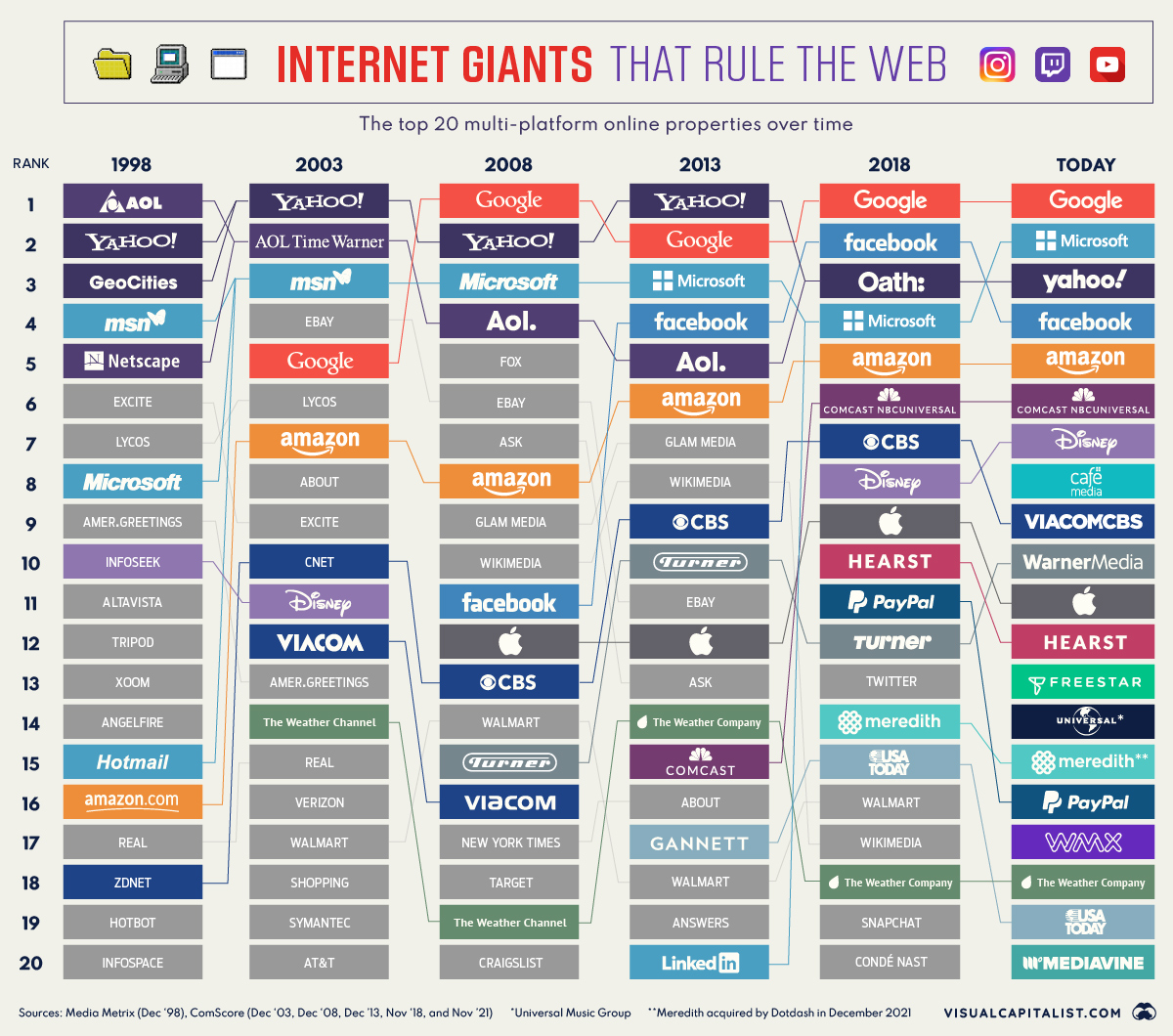
    So, how much has the Internet changed, and who are today's top players? Take a look at this chart and you'll see quite a bit of transience. Some of yesterday's lions only eke out a faint, weary roar today, while several others, like Google, are still going strong.


    So, what should we make of a chart like this? What does this visual tell us about the online marketplace?

    There are two useful takeaways:

    1. The diversity within this chart showcases how fluid market dominance can be. Yesterday's rock stars aren't necessarily today's sensations. On the whole, the Internet is still quite young, and companies rise, fall, merge, acquire, and pivot. And, with the emergence of Web3, and its emphasis on diffusion and decentralization, the next decade could bring with it a host of new players.

    Consider the increased interest in data privacy, hopefulness surrounding cryptocurrency, and the growing distrust of Big Tech, and you begin to wonder if another iteration of the Internet might not be too far off.

    2. In recent years, Google, Microsoft, Yahoo, Facebook (aka Meta), and Amazon have nestled into leading positions. Their market dominance has created the digital infrastructure that virtually every other website or business utilizes in some way or another. But these top companies' large market share is far from a clean-cut matter. With rising concerns over privacy, censorship, government interference, and more, the stakes for getting tech policy right are pretty high.

    The John Locke Foundation is an ardent and dogged defender of free markets and limited government. We will obstinately fight toxic cronyism, that pernicious distorter of prices and markets. We have faith that businesses can effectively make their pitches directly to customer. Americans don't need politicians to prop up one business to the detriment of another, or use tech companies to do their partisan bidding.

    If you're interested in learning more about free-market solutions in tech and discussing your own experiences with this shifting, sometimes frustrating, landscape, I invite you to join me at the Carolina Liberty Conference. I'll be speaking with a panel of tech and media experts to explore challenges and solutions as we prepare to enter a new era of the Internet.
Go Back


Leave a Guest Comment

Your Name or Alias
Your Email Address ( your email address will not be published )
Enter Your Comment ( text only please )


Progressive Indoctrination in Public Schools Takes Many Forms John Locke Foundation Guest Editorial, Editorials, Op-Ed & Politics The NC Threat-Free Index and Immunity Update for the Week Ending January 31


HbAD0

Latest Op-Ed & Politics

government's offer is rejected, the battle continues, no confidence vote in parliament

HbAD1


HbAD2

Understanding how parties work is important for making informed decisions regarding elected officials.

HbAD3


Back to Top