Publisher's note: We believe the subject of history makes people (i.e., American people) smarter, so in our quest to educate others, we will provide excerpts from the North Carolina History Project, an online publication of the John Locke Foundation. This eighty-sixth installment, by Troy L. Kickler, was originally posted in the North Carolina History Project.
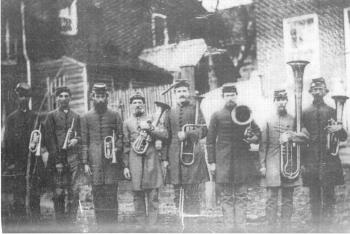
Members of the Salem Brass Band on furlough in summer 1862. Image courtesy of the Moravian Music Foundation, Winston-Salem, NC.
Members of the Salem Brass Band on furlough in summer 1862. Image courtesy of the Moravian Music Foundation, Winston-Salem, NC.
Members of the Salem Brass Band on furlough in summer 1862. Image courtesy of the Moravian Music Foundation, Winston-Salem, NC.
Members of the Salem Brass Band on furlough in summer 1862. Image courtesy of the Moravian Music Foundation, Winston-Salem, NC.
Formed out of Moravian musical societies and community bands that exemplified the traditional importance of brass instruments, particularly the trombone, the Salem Brass Band served the Confederacy from the first days of the Civil War until June 1865, when members were finally released from prison. More than its fundraising concerts or its members' valuable service as medics, the band’s affiliation with the 26th North Carolina Infantry, the regiment that suffered the most casualties of any unit at the Battle of Gettysburg (July 1-3, 1863), may be its claim to fame.
From June 1861 to mid-1863, the Salem Brass Band remained primarily in the Old North State. In 1861, it participated in many campaigns in Eastern North Carolina, including the Battle of New Bern (March 14, 1862). Bandsmen were deployed later to Virginia in 1862 to assist thwarting McClellan’s Peninsula Campaign (June 25 to July 1, 1862). While in Old Dominion, they served as medics as they had done in past battles and would do in subsequent ones. Furloughs were granted late summer 1862, and the men visited family and held fundraising concerts. General Zebulon Vance extended their furloughs (more than likely so band members could vote in the gubernatorial election). After the Buncombe County native won, bandsmen gave concerts across Eastern North Carolina, playing a piece one of them composed: “Governor Vance’s Inauguration March.”
The second half of the war (May 1863-May 1865) treated the Salem Brass Band more harshly. Assigned to the 26th North Carolina Infantry, bandsmen witnessed horrific casualty rates and assumed a role after Gettysburg in restoring the morale of a demoralized Confederate army. Although the men asked for furloughs frequently, their requests were always denied (Even Governor Vance ignored their petitions). In 1864, the bandsmen endured not only homesickness but also the rigors of extended camp life, including hunger, the elements, and lice-infested clothes, and commanders started assigning the Moravians to perform military duties such as guarding wagon trains. A few days before General Robert E. Lee’s surrender at Appomattox, Union forces captured the Salem Brass Band and held bandsmen captive in Maryland until mid-1865. Remarkably, in conflict and as prisoners of war, bandsmen remained a unit during the entire war.
 Moravian Bone Ensemble: Above.
Sources:
Moravian Bone Ensemble: Above.
Sources:
Harry H. Hall, A Johnny Rebel Band from Salem: The Pride of Tarheelia (Raleigh, reprint, 2006).