Sacred Heart Cathedral | Eastern NC Now

Sacred Heart Cathedral is the Mother Church for the Roman Catholic Diocese of Raleigh, making it the spiritual center for Catholics in eastern North Carolina.

ENCNow
    Publisher's note: We believe the subject of history makes people (i.e., American people) smarter, so in our quest to educate others, we will provide excerpts from the North Carolina History Project, an online publication of the John Locke Foundation. This one hundred and sixth installment, by Will Schultz, was originally posted in the North Carolina History Project.

    Sacred Heart Cathedral is the Mother Church for the Roman Catholic Diocese of Raleigh, making it the spiritual center for Catholics in eastern North Carolina. It is the smallest cathedral in the continental United States. Sacred Heart's parochial school was desegregated in 1953, a year before the Brown v. Board of Education decision.

    There was no Catholic church in Raleigh for nearly a century. During the 1860s Catholics worshipped in an old Baptist church on Wilmington Street. They later moved services to the top floor of the Briggs Hardware store. In 1879, Father James White purchased the Pulaski-Cowper mansion, where masses were held in the former ballroom.

    These were only temporary solutions, and in 1922 construction began on Sacred Heart Church. The small granite church was completed late in 1924; the first mass in the building was celebrated on October 16. Meanwhile, Vatican officials were searching for a headquarters for the Catholic diocese in North Carolina. Wilmington and Asheville were the leading candidates. But Father Thomas Griffin, pastor of Sacred Heart, argued that the diocese ought to have a central location. The Vatican considered his arguments persuasive. They named Sacred Heart the cathedral for the Raleigh Diocese in December 1924.
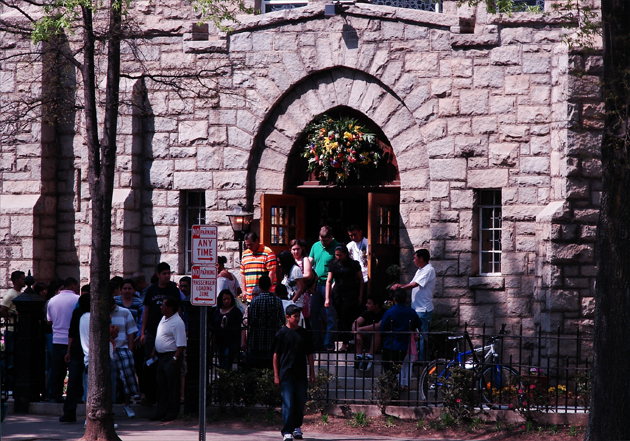
A Saturday afternoon wedding at Sacred Heart Cathedral: Above.     photo by Stan Deatherage

    The Catholic school predated the cathedral. In 1909, Father Thomas Griffin and four nuns founded Sacred Heart Parochial School and Sacred Heart High School. The schools moved into the Pulaski-Cowper mansion after the cathedral was built; in 1936 they moved again, to a new granite building on Hillsborough Street. The Sacred Heart schools became the center of controversy in 1953, when Bishop Vincent S. Waters integrated all Catholic schools and churches in North Carolina. The next year, Sacred Heart High School began accepting black students from St. Monica Grade School. Sports teams from other schools refused to play the integrated Sacred Heart team, so the bishop canceled all sporting events from 1953 until 1955.

    Vatican II brought major changes to Sacred Heart. The Vatican II council, a meeting of the Catholic hierarchy held in Rome from 1962 until 1965, "modernized" Catholicism by updating the Church's ancient traditions. After the council was over, Raleigh Catholics renovated Sacred Heart to make it less traditional. The original marble altar and two angel statues were removed, and the elaborate designs on the cathedral floor were covered with plain red tile. The bishop's red oak throne was placed in storage. The priest conducted his service in English, not Latin. A few Catholics in the congregation, however, maintained traditions. For instance, even after the cathedral's kneelers were removed, one elderly woman persisted in kneeling on the cold tile floor.

    The cathedral itself changed little from the 1970s to the mid-1990s, but the Catholic Church in North Carolina experienced rapid growth. Between 1988 and 1998, the Raleigh diocese's Catholic population doubled from 65,000 to 148,000. As of 2010, the diocese served more than 215,000 Catholics. Many of these new parishioners were Hispanics. By 2000, more than half the parishes in the Raleigh diocese offered a Spanish Mass.

    Sacred Heart made a return to tradition with the advent of the new millennium. In 1998, the cathedral underwent a $500,000 facelift. Many of the renovations reversed the changes made after Vatican II. The red tiles were stripped away to reveal the original floor. The kneelers and the bishop's throne returned. The ceiling was repainted a dark blue and decorated with fourteen-carat gold stars. Even Latin was reintroduced into the worship. Sacred Heart began offering a monthly Latin Mass in 2007, after Bishop Michael Burbidge received dozens of requests to restore the traditional service.

    The cathedral's small size is inadequate for Raleigh's growing Catholic community. Sacred Heart can hold only 350 people at one time. Yet the cathedral has nearly 6,000 parishioners. This lack of space has led Bishop Burbidge to propose the construction of a new, larger cathedral. For now, Sacred Heart remains Raleigh's Mother Church.

    Sources:

    "CGHS History,"

    http://www.cghsnc.net/Portals/0/About%20Us/CGHS%20History.pdf (Accessed May 24, 2010); News & Observer, June 8, 1994; September 12, 1995; November 27, 1998; May 1, 2000; January 7, 2008; April 13, 2010; "Raleigh's Sacred Heart Cathedral: Ecclesiastical Grandeur in a Small Package," http://goodnightraleigh.com/2009/03/raleighs-sacred-heart-cathedral-ecclesiastical-grandeur-in-a-small-package/ (Accessed May 24, 2010).
Go Back


Leave a Guest Comment

Your Name or Alias
Your Email Address ( your email address will not be published )
Enter Your Comment ( text only please )


Earl Scruggs (1924 - 2012) NC Past (Archive), In the Past (Archive), Body & Soul ECU, Vidant Medical Center provide gift of life via four-person kidney exchange


HbAD0

Latest Body & Soul

The great misnomer for non Christians that the day Jesus Christ was executed by occupying Romans, celebrated by Christians as "Good" Friday, must be a paradox of ominous proportions.
North Carolina could provide a scalable blueprint for integrating food into the health care system, following the success of NourishingWake, a program by NourishedRx.
NYC Archbishop rejects hate-filled rhetoric from online personalities, citing the sacredness of human life and the Church’s historical failures.
A group seeking COVID-related records from the University of North Carolina at Chapel Hill is urging the North Carolina Supreme Court to take its case.

HbAD1

The North Carolina Department of Health and Human Services has received funding for the 2026 Low Income Home Energy Assistance Program (LIHEAP) from federal partners.
Republican leaders of the North Carolina General Assembly have rejected Gov. Josh Stein’s call for an extra legislative session dealing with Medicaid next week, calling the move unconstitutional and unnecessary.
I am not a veteran. I only have the greatest respect for those who have served, unsurpassed by all professions that keep America safe and strong.
State health officials are investigating a suspected case of infant botulism in North Carolina linked to a baby formula, which has now been recalled nationwide.

HbAD2

The NC General Assembly has wrapped the scheduled October session, but tensions are still running high between the chambers over a Medicaid rebase stalemate and its increasing sticker shock.

HbAD3


Back to Top