Publisher's note: The author of this post, Kathryn Kennedy, is a contributor to ECU News Services.
AMA speaks to the future of medical education during visit to ECU
Education for health care professionals in the 21st century must focus on teamwork and interdisciplinary training, individualized learning for students and patient-centered care. That was the message delivered by American Medical Association representatives visiting East Carolina University on March 25.
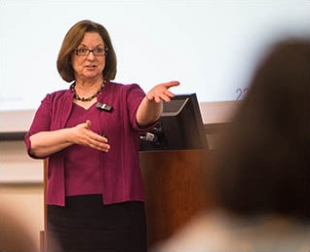
American Medical Association representative Susan Skochelak speaks to a gathering of ECU professors engaged in the REACH program (Redesigning Education to Accelerate Change in Healthcare). (Photos by Cliff Hollis)
Susan Skochelak and Rich Hawkins, both of the AMA's Medical Education Programs, were among those who spoke to ECU health sciences educators this week.
The Brody School of Medicine is one of 11 medical schools nationwide that received grants through the AMA's Accelerating Change in Medical Education Initiative, which aims to change the way medical education is taught.
Read more about the grant here.
ECU calls its program Redesigning Education to Accelerate Change in Healthcare, or REACH.
Session attendees were the 38 members of the ECU Teachers of Quality Academy, meeting throughout this week. The academy includes Brody doctors as well as professors from the College of Allied Health Sciences, the College of Nursing and medical residents.
"This is too big of a job for one medical school to do," Skochelak said. "Clearly your aspirations are high here and I congratulate you on what you started."
Skochelak said the AMA hopes to rapidly prototype and test new or unique educational models enacted at the participating medical schools. The organization's goals for medical education include the following:
- To move from competency-based assessment to flexible, individual learning plans;
- To find methods that achieve patient safety, performance improvement and patient-centered team care;
- To ensure all health care professionals understand the health care system and health care financing.
Each of these goals will confront increasing health disparities, cost variation and other emerging issues, Skochelak added.
Brody School of Medicine Dean Dr. Paul Cunningham lauded the Teachers of Quality Academy for taking on "the nitty-gritty work that's required to transform medical education." He noted that in eastern North Carolina, Brody is serving "some of the sickest people in the nation."
"It's an opportunity," he concluded, "for us to do something revolutionary right here in the East...that is immediately applicable across the United States of America."
The March 25 morning session also included a panel of health care educators discussing the educational standards and trends in clinical training, residency and nursing. Participants were Dr. Luan Lawson, Dr. Herb Garrison and Donna Lake, all of ECU, and Dawkins of the AMA.
Dawkins fielded a question from an ECU educator about how individualized learning will change the number of years a student attends the university or a residency program.
"The important change is putting the emphasis on achievement, not just on timing," he responded.
Skochelak stated that flexibility in learning pathways could mean accelerated coursework for some or, for others, more time spent in school or training.
More information about ECU's REACH program is available online at
http://www.ecu.edu/reach.

ECU physician Dr. Toni Johnson, a member of the Teachers of Quality Academy, asks questions of the AMA representative visiting ECU March 25.
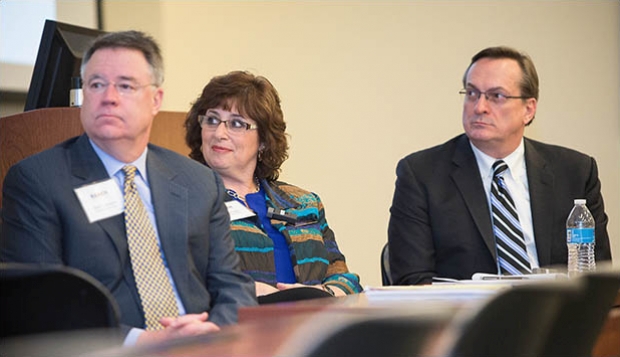
Panel members included, left to right, ECU physician Herb Garrison, ECU nursing professor Donna Lake and AMA representative Richard Hawkins.