Publisher's Note: This article originally appeared in the Beaufort Observer.
Jane Stancill, writing in the
News & Observer has an excellent summary of the UNC Board of Governors' pending decision on raising tuition. The board is meeting today (2-9-12) and tomorrow to decide. As Stancill reports, UNC President Tom Ross is recommending a 8.8 percent increase but the board is split and coming under unusual pressure to deny the proposal.
Stancill then goes on to focus on the harmful impact an increase in tuition will mean for students, a couple of whom she profiles.
The administration claims they need to tuition increase to offset cuts in state appropriations in this year's budget. Yet when you examine the audit reports from the individual campuses you will be hard pressed to find even one that shows a reduction in spending. Most show substantial increases and nearly all show an increase in net assets on their balance sheets.
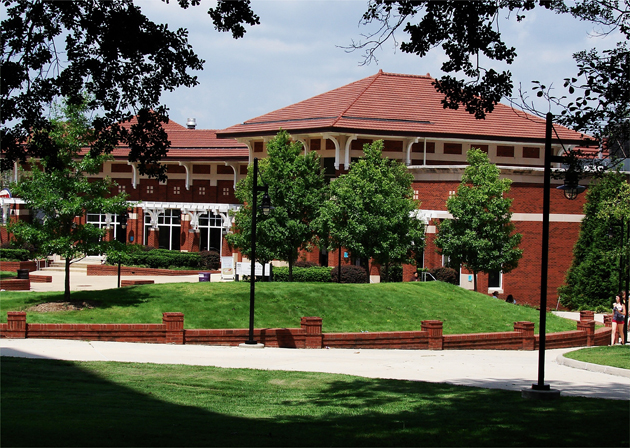 East Carolina University photo by Stan Deatherage
In other words, there is no evidence other than hand wringing anecdotal assertions to support the necessity for tuition increases.
But we will be pleasantly surprised if the board vetoes the increases.
Commentary
Traditionally, the individual campuses have exhibited a fixation that "more money is necessary." They don't have it within their DNA to reduce spending, no matter how unjustified prior spending was. So when times are good they lobby the legislature for more tax money. Then when times get tight--as the inevitably do--they argue that the student must cough up what the legislature does not do.
And the audit reports prove this. Track expenditures over time and what you see is a steady increase. Always, everywhere.
No private business would operate like this. When income goes down, you cut expenditures...if you want to stay in business. But this idea is foreign to our university system.
Moreover, if the universities were half as smart as many of those who run them believe themselves to be they would seize budget contractions as a vehicle for improving quality. They would admit fewer, and better students. Instead, enrollment trends go up, up and up. Then we hear that many student require remedial basic course. How much sense does that make?
Advocates for tuition increases claim that they are necessary to keep top quality faculty. But turnover is low.
And much of the increase in expenditures is not for faculty. It is for non-instructional spending.
Just one example: The proposed 8.8% increase in tuition could be avoided, with abundant excess left over if President Ross were to simply dictate that "every faculty member will teach a full load." By full load we mean that they will teach five courses per week, or 15 hours (yep, teaching 15 hours is considered a full load). If a faculty person is release for other duties their salary is divided proportionately between faculty salary appropriations and appropriations for whatever they are released to do, none of which may be funded by tuition or fee revenue. There. That eliminates the need for a tuition increase. So that is proof that the tuition increase is not necessary to "keep faculty." In fact, the full load requirement would leave abundant funds to give exceptional faculty substantial raises.
But if President Ross and the Board are going to confiscate more money from students they should at least mandate one other change. That is, they should require all necessary course material to be posted online. Prohibit any faculty member from collecting a royalty from any material used in class. In some instances the cost of books and course materials exceed tuition. That is a scandalous situation, but rooted in the same "more money" culture that drives the tuition increases. It is that culture that President Ross should be working to change.
Finally, President Ross and the Board should begin the phase out of compulsory fees. The fee system should be changed to make those who benefit from a service (such as transportation, recreation, athletics, health etc.) should subscribe to those services with fees based on "pay to use" rather than on a communistic system of "make everyone pay for what only a few benefit from."
The cost of attending one of our larger universities could be reduced substantially if compulsory transportation fees were not assessed on everyone. Over time, more dorms would replace the transportation expenses that now mainly benefit private property owners who charge exorbitant rents for student housing.
Beyond all this, it is time (past time actually) for the UNC system to eliminate the first two years of "basic studies." Those should be taught in the community college system on a non-residential basis. The university system would focus on junior and senior major-studies and graduate studies. And that would greatly reduce the cost of higher education, improve quality and "improve" the social life of many of our young people.