Stormy Outlook | Eastern NC Now

Mangrove forest study has takeaways for coastal communities

ENCNow
Publisher's Note: This post appears here courtesy of ECU News Services. The author of this post is AUTHORNAME.

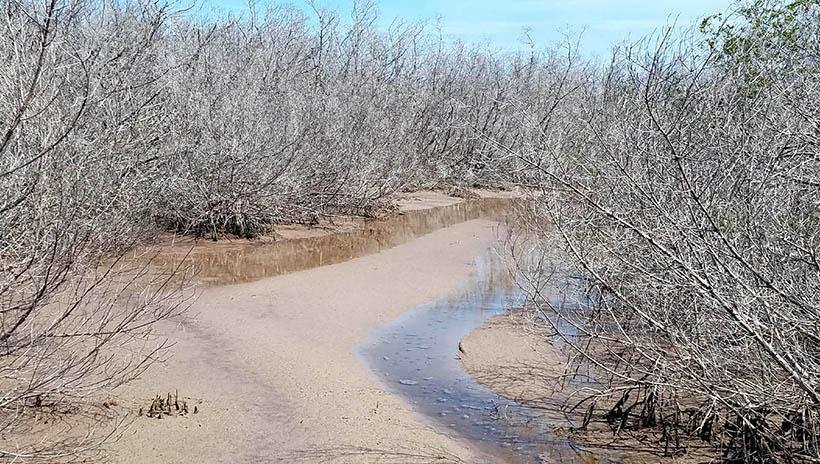
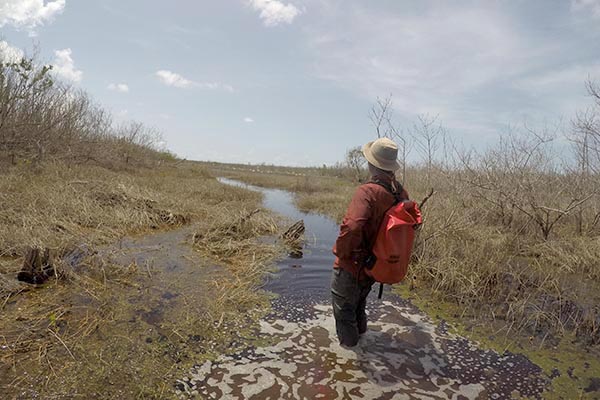
A research study led by East Carolina University assistant professor David Lagomasino studied potential reasons for mangrove forest dieback in Florida after Hurricane Irma in 2017. His findings could have implications for how other states, like North Carolina, manage the coast to prepare for extreme weather events. | Photos: Contributed

    A new paper published by an East Carolina University researcher in the Department of Coastal Studies shines light on the effect human-made infrastructure and natural topography has on coastal wetlands after major storm events.

    In partnership with NASA and Florida International University, the study, led by assistant professor David Lagomasino, was published in the July edition of Nature Communications.

Despite resilient grow back in the past, Lagomasino and his research team estimate that nearly 11,000 hectares of mangrove forest, about 27,000 acres, failed to regrow at their previous levels after Hurricane Irma.
    The study focused on the effects of Hurricane Irma, which struck Florida in 2017, and the damage it caused to the state's mangrove forests. The research team found that the forests suffered unparalleled dieback after the major hurricane.

    Mangrove forests are often damaged after hurricanes, but Lagomasino said forests in Florida have shown great resiliency in the past due to their structure, position and species composition. After Hurricane Irma, the forests did not rebound at the same rate. Nearly 11,000 hectares — a space the size of more than 24,000 football fields — showed evidence of complete dieback following the storm.

    For a resource that prevents more than $11 billion in annual property and flood damage in the state, that's a major concern, Lagomasino said.

    "There have been significant storms in the past that have led to damage, but Irma seems to have caused one of the largest areas of dieback, at least in the satellite record," Lagomasino said.

    After studying satellite and aerial footage of the region, the research team was able to pinpoint potential explanations for the dieback, including human-made obstacles.

    "Human-made obstacles, as well as natural changes in topography, can impact the flow of water through an area," Lagomasino said. "Things like roads and levees can restrict or stop the flow of water between areas that were once connected. The lack of connection between the water can lead to extremes — extreme dry conditions and extreme wet conditions, both of which can be stressful on wetland vegetation that thrives in more stable conditions."

    The study noted that human-made barriers can lead to an increase in how long water stays on the surface, which can cause rapid degradation of fine root materials. Increased saltwater ponding may occur when storm surge is high and barriers obstruct water flow.

    These results are not only key for future storm planning in Florida, but other coastal states like North Carolina, Lagomasino said.

    "What we have learned in Florida can be useful to North Carolina and other coastal regions," Lagomasino said. "Our results indicate that the elevation of the landscape, the connectivity of water across the landscape, and the height of storm surge can indicate vulnerable areas. In other words, low elevation areas that are disconnected or do not have the capability to drain after being flooded are more susceptible to long-term damage.

    "This is useful for understanding the resilience of coastal forests and wetlands in North Carolina and may also be important in predicting urban areas that may also be less resilient to these extreme events."

    The study suggested changes that can be made to improve coastal resiliency in the future when facing severe weather events, including:

  • Adding new metrics that account for storm surge and geology to the traditional hurricane rating system;
  • Establishing field research stations in low-lying areas to help identify underrepresented physical and biological processes in vulnerable regions;
  • Performing regular coastal remote sensing surveys to monitor drainage basins and improve water connectivity; and
  • Improving freshwater flow to help create new tidal channels.

    "We hope that the information from our research will help improve the recovery process after storms," Lagomasino said. "If these areas can be identified ahead of time, then the disaster response can address issues in hard-hit areas much faster or minimize the impact beforehand.

    "The big takeaway here is that intense winds do a lot of damage during hurricanes. However, the intensity of damage does not necessarily coincide with the ability of the system to recover over time. Other factors, like slight changes in the elevation of the coastal landscape and storm surge, play a significant role in how the ecosystem recovers or does not recover after the initial damage. Having these factors in mind prior to hurricane season can help lessen long-term impacts in vulnerable communities."
Go Back


Leave a Guest Comment

Your Name or Alias
Your Email Address ( your email address will not be published )
Enter Your Comment ( text only please )


Increasing Student Involvement East Carolina University, School News, The Region, Neighboring Counties Student: Christian Penister


HbAD0

Latest Neighboring Counties

A North Carolina State Senate race is heading for a recount after the two pro-Trump Republicans come down to a two vote margin.
This is simply a failure of will, and we are here to help impose that will today, so that to me is the simple punchline," said State Treasurer Brad Briner. "I appreciate the leaders of Rocky Mount being here, but we need to get to a place where there is the will to fix a very, very serious problem.”
A federal judge will not issue an injunction blocking local Watauga County election districts created by the Republican-led North Carolina General Assembly.
The FBI has captured Alejandro “Alex” Rosales Castillo, who is on the 10 Most Wanted Fugitive list and wanted in connection with a 2016 murder in Charlotte.
A major redevelopment project planned in Morehead City has been scrapped following strong public opposition over the use of eminent domain.
In the coming months, the North Carolina Supreme Court will decide whether a class-action lawsuit can move forward against Raleigh over water and sewer impact fees.
Former congressman Wiley Nickel made his candidacy for the office of Wake County district attorney official this week, with his Tuesday announcement.
Groups representing North Carolina's travel and tourism industry support a lawsuit against Currituck County at the North Carolina Supreme Court.
Plaintiffs in a $16 million class-action lawsuit against Raleigh challenged the city's legal tactics in a new state Supreme Court filing.

HbAD1


Back to Top