Publisher's note: Agenda 2012 is the John Locke Foundation's charge to make known their wise political agenda to voters, and most especially candidates, with our twenty-ninth instalment being "Hydraulic Fracturing," written by Jon Sanders, Director of Regulatory Studies at the John Locke Foundation. The first installment was the "Introduction" published here.
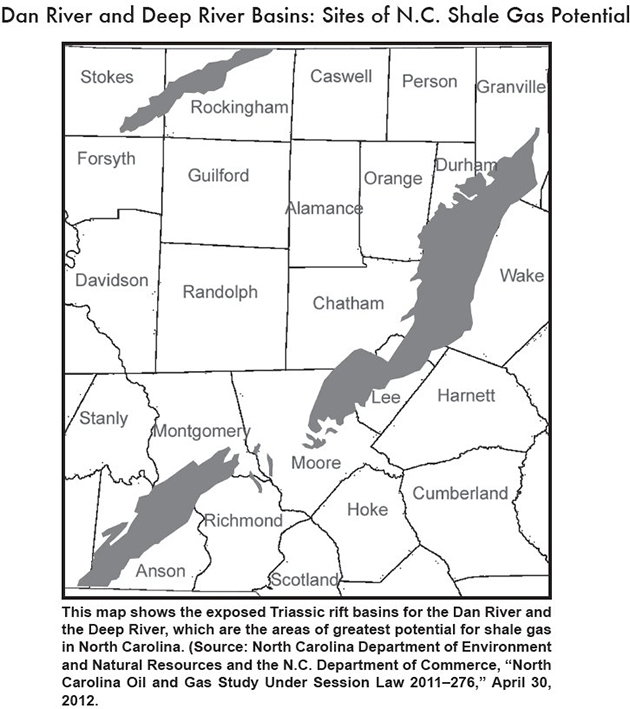
The presence of natural gas in shale rock formations, such as in the Deep River Basin in Lee, Chatham, and Moore counties, has long been known. Hydraulic fracturing ("fracking"), a process to extract natural gas from shale, has been around since the 1940s but has been cost-prohibitive. Very recent technological advances in combination with horizontal drilling have turned fracking into a low-cost method to recover natural gas. It has revolutionized the industry, bringing jobs and booming economies to local drilling sites and energy independence to the shale-rich United States. But North Carolina is one of just two states in the union that bans the process. (In late May, Gov. Peter Shumlin of Vermont signed that state's largely symbolic ban.)
Key Facts
• In 2011 the N.C. legislature passed a bill that would have led to a review and likely changes in state law with respect to hydraulic fracturing. Gov. Bev Perdue vetoed it, but in 2012 Perdue publicly changed her position on the viability of fracking in N.C.
• In May 2012, fulfilling a request by the legislature, the N.C. Department of Environment and Natural Resources issued a report which concluded that fracking could be done safely here with the proper regulations in place.
• Concerns over fracking include whether it could contaminate drinking water through either escaping methane gas or the chemicals used in fracturing the underground rock, whether underground fracturing causes earthquakes, and whether the increased trucking to and from drill sites creates congestion and air pollution.
• Numerous studies have found no link between hydraulic fracturing and groundwater contamination. Even U.S. Environmental Protection Agency administrator Lisa P. Jackson, testifying under oath before Congress in May 2011, stated she was "not aware of any proven case where the fracking process itself has affected water, though there are investigations ongoing."
• Documented incidents of water pollution related to fracking have been found to be caused by faulty well construction, almost always owing to poor cement jobs. Those may be prevented by stricter regulation on well construction.
• Ohio regulators found that earthquakes thought to be linked to hydraulic fracturing were actually caused by wastewater injection into deep disposal wells. Several industrial activities other than hydraulic fracturing generate such wastewater. Ohio responded with tighter regulations on deep disposal wells.
• During his State of the Union Address of 2012, President Barack Obama hailed the benefits -- from job creation to cheaper, cleaner electricity and fuel -- of being able to extract natural gas from shale rock.
• A December 2011 PricewaterhouseCoopers study of the economic effects of shale gas development in the United States through 2025 predicted more affordable energy, higher demand growth for U.S. manufacturing, and approximately one million more workers in U.S. manufacturing jobs.
• As Daniel Fine of the New Mexico Center for Energy Policy has observed, the land in North Carolina with the potential for recoverable gas and oil is private or fee land, not federal or public. In recent years nearly all gas and oil production in the United States has occurred on private or fee land.
• Late entry to hydraulic fracturing would position state regulators to observe and apply the best practices of other states, such as regulations concerning well construction and disclosure of fracking chemicals.
Recommendations
Allow hydraulic fracturing and energy exploration in North Carolina. State officials should study best practices in states that have worked through regulatory issues regarding fracking, but the state should not block a potentially strong source of job creation, energy affordability, and economic growth. Caution is justified, but not inaction.
Set up a regulatory body specifically devoted to natural gas and oil. Board membership should be carefully crafted to foster dispassionate scientific and economic analysis as well as to ward off regulatory capture of one kind or another.
Analyst: Jon Sanders
Director of Regulatory Studies
919-828-3876 •
jsanders@johnlocke.org