Publisher's Note: This post appears here courtesy of the John Locke Foundation. The author of this post is Kelly Lester.
Farming subsidies have been a contentious issue in the agricultural industry for years. Although they were initially designed to support smaller farmers, they have ultimately ended up harming them. In this article, we will examine some of the ways in which farming subsidies have had adverse effects on smaller farmers.
Firstly, farming subsidies have caused the consolidation of farms. According to a report by the Environmental Working Group, from 1995 to 2021, the top 10% of farm subsidy recipients received 78% of all subsidies, while the bottom 80% received only 9 percent. These subsidies are often allocated based on acreage, which favors larger farms over smaller ones. As a result, the number of small to mid-sized farms has decreased since 1982, while the number of large farms has doubled. This has led to the growth of large, industrial farms, which can take advantage of economies of scale to produce crops at a lower cost than smaller farms. This can be seen in the figure below, which shows the number of farms declining while the average farm size continues to increase.
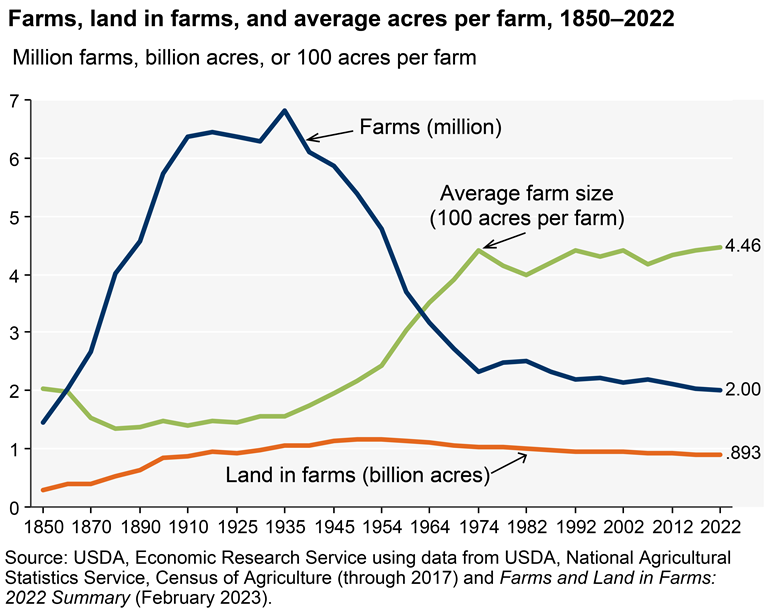
For context, when I say small to midsize I am not including very small farms that cater to a niche consumer looking for locally sourced organic produce. In fact, there is some evidence that these very small, often run by a single family, farms which focus on organic produce have increased in recent years. This is most likely due to an uptick in demand for more organic produce and transparency in the food industry.
Secondly, farming subsidies distort the market and result in overproduction. Between 1995 and 2021, the top 1% of farm subsidy recipients received around a fourth of total subsidies, more than all the subsidies given to small farmers combined. This has incentivized farmers to produce more crops, regardless of market demand, resulting in an oversupply that depresses prices. Small farmers are unable to compete with larger farms that can absorb these fluctuations, leading to financial losses and the inability to cover their production costs.
Lastly, farming subsidies create a dependence on government assistance. According to the Congressional Research Service, in 2020, 39% of farm income came from government subsidies. This has led to farmers becoming reliant on government assistance and less likely to invest in new technologies or explore alternative markets. This, in turn, has led to stagnation in the agricultural industry, as farmers are not incentivized to innovate or improve their operations. Smaller farmers are particularly vulnerable to this dynamic, as they have fewer financial resources to invest in their operations without government assistance.
In conclusion, farming subsidies have had a significant negative impact on smaller farmers. They have resulted in the consolidation of farms, market distortion, the favoring of large agribusinesses, and a dependence on government assistance. While these subsidies were intended to support small farms, they have ultimately led to their decline. It is crucial for policymakers to prioritize the needs of smaller farmers and consider the impact that subsidies have on the industry.
poll#166