Criteria Recommendations for North Carolina Congressional Maps | Eastern NC Now

Though North Carolina passed its newest budget last week, the legislature will still be busy this week.

ENCNow
    Publisher's Note: This post appears here courtesy of the John Locke Foundation. The author of this post is Jim Stirling.

    Though North Carolina passed its newest budget last week, the legislature will still be busy this week. The legislature still must draw new congressional and legislative maps following the North Carolina Supreme Court's reversal in the Harper v. Moore Case earlier this year.
    The legislature's joint redistricting committee is having meetings this week at three locations throughout the state to allow for public comment on the redistricting process. The first was at the College of the Albemarle campus in Elizabeth City. Here are the two other locations with links to the public to sign-up.

    Tuesday, Sept. 26th: Appalachian State University, Hickory Campus

    Wednesday, Sept. 27th: Legislative Office Building, Raleigh

    The legislature must establish two sets of criteria, one for legislative and the other for congressional maps, to comply with statutes and prior court rulings. Due to the inherent complexity of state house and senate redistricting, I'll only be addressing my recommendations for the criteria for the congressional maps. My colleague Dr. Andy Jackson and I wrote in detail our recommendations for redistricting criteria and the application of said criteria in a study published earlier this year.

    For the congressional redistricting, the legislature should mostly adhere to the criteria the committee used during the 2021 redistricting process. The only exclusions to the prior criteria I suggest are removing the consideration of member residences and splitting counties or precincts to prevent double-bunking.

    In our study on limiting gerrymandering in North Carolina, we restricted research participants to only splitting counties and precincts a maximum of thirteen times each. We also required that they maintain the ten largest municipalities' "core precincts" in one district. For municipalities that stretch across county lines, we did not require these precincts to be included in this requirement. We defined "Core Precincts" as contiguous precincts fully incorporated within a municipality. North Carolina's ten largest cities are:

  1. Charlotte 873,579
  2. Raleigh (Wake) 466,106
  3. Greensboro 299,035
  4. Durham (Durham) 283,093
  5. Winston-Salem 249,545
  6. Fayetteville 208,501
  7. Cary (Wake) 171,012
  8. Wilmington 115,451
  9. High Point (Guilford) 107,321
  10. Concord 105,240

HbAD0

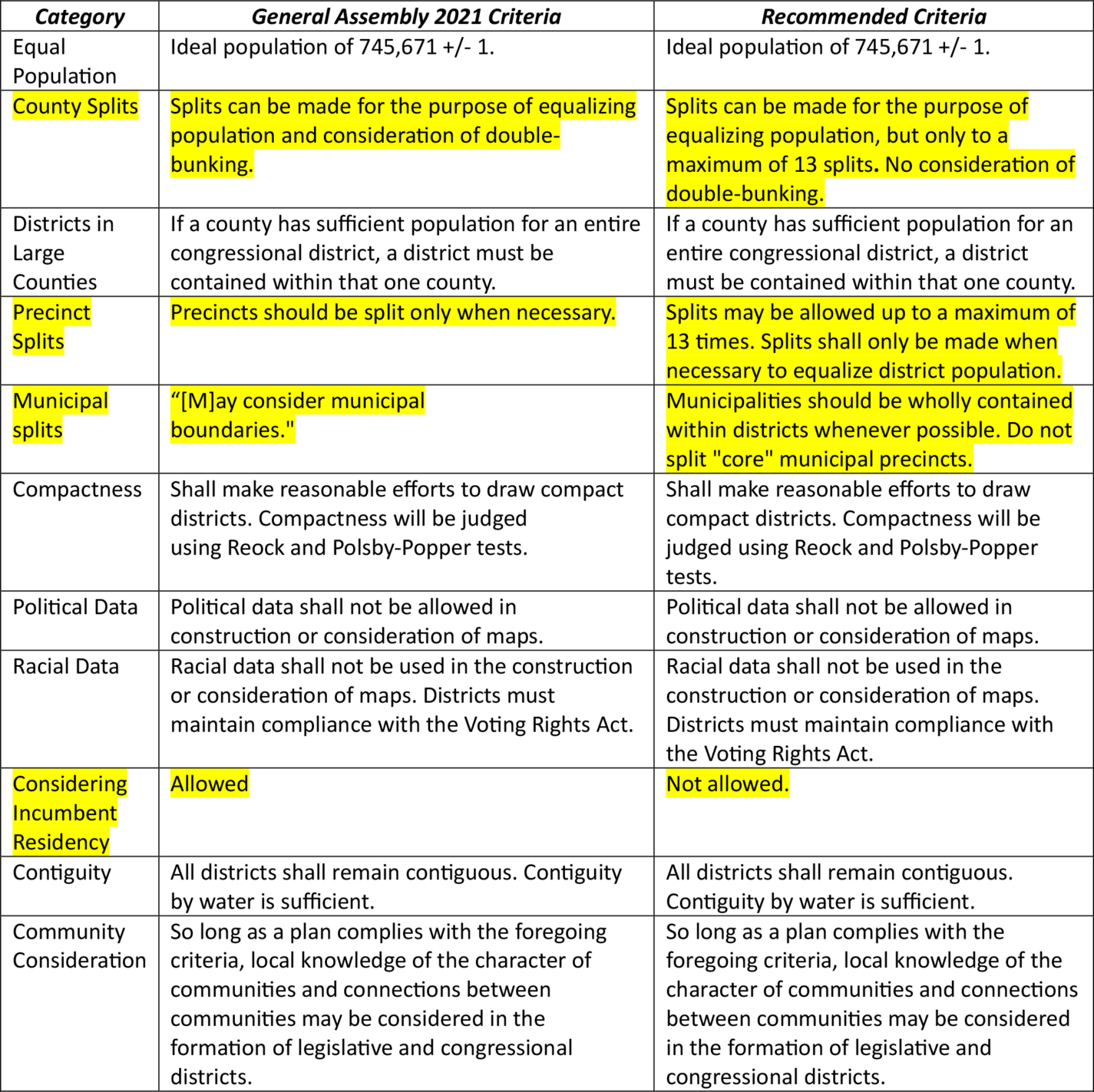
    I'm recommending the committee adopt the criteria I've laid out above while keeping its 2021 criteria for equal population, establishing a self-contained district in counties that exceed the ideal population within them, compactness, contiguity, community consideration, and excluding the use of partisan and racial data from the consideration of maps. A list highlighting my recommendations compared to the legislature's 2021 criteria can be found below. All changes to the committee's criteria have been highlighted.


    Utilizing traditional redistricting criteria, banning the use of political and racial data, and focusing on maintaining municipalities and other communities of interest not only establishes good practices for North Carolina's redistricting going forward, but also adheres to North Carolina's political geography. By utilizing a strict set of criteria, we prevent the gamesmanship of political maps by both the legislature and activists who consistently push for outcomes that defy evidence of the most likely outcomes for North Carolina maps.
Go Back

HbAD1

Latest Bloodless Warfare: Politics

Tax Day is a week away, and the reports are in: North Carolinians are winning big with record-setting tax returns thanks to President Trump and Republicans' Working Families Tax Cuts.
Change in schedule for executive committee meeting. Meeting Thursday April 9 is cancelled.
After years in the limelight for his combative style both with Democrats and his fellow Republicans, Crenshaw's future now unsure.
If he wins in November, Teixeira will be the all-time Congressional home run leader.
The county boards of elections in Guilford and Rockingham counties on Tuesday morning will begin a partial hand recount of ballots in randomly selected precincts in the N.C. Senate District 26 contest between candidates Phil Berger and Sam Page.
The 1926 Beaufort County Republican Convention will be held at the court house on Thursday April 6 at 6:00 PM. Be there by 5:30 in order to register. There is a 5 dollar fee.

HbAD2

Senate President Pro Tempore Phil Berger has requested a recount in the SD-28 Republican primary against challenger Sheriff Sam Page, after the race ended with one of the narrowest margins in recent North Carolina election history.
North Carolinians are feeling historic relief this tax season thanks to President Trump and Republicans' Working Families Tax Cuts, as the average refund tops $3,700.
(RALEIGH) Today Governor Josh Stein and First Lady Anna Stein visited Green Magnet Elementary School and read to students in celebration of Read Across America Day.
In-person early voting for the 2026 primary election begins Thursday and ends at 3 p.m. February 28 in all 100 counties.
On occasion, the election season has a way of bringing forth much good fruit, which is often the case when hard working and intelligent agents of stability, through changing the dynamic of our societal path, join the political paradigm to help we, the self-governed, do far better for ourselves.
In Commissioner Deatherage's Campaign for Re-election, as your Conservative County Commissioner, Washington Mayor Pro Tem Nick Fritz endorsed Candidate Stan Deatherage to remain in office to lead a Conservative renaissance here in Beaufort County.

HbAD3

The Republican party has transformed in a number of ways over the past 20 years.

HbAD4


Back to Top