Publisher's note: The author of this post is Katherine Restrepo, who is the Health and Human Services Policy Analyst for the John Locke Foundation.
At face value, the Affordable Care Act (ACA) granted health insurance companies a pretty sweet deal. People are required to purchase their products under the law's individual mandate.
But it comes with many strings attached in the form of government regulations. Insurers must now accept everyone, regardless of health status, and they are prohibited from pricing premiums based on the amount of risk individuals bring to the insurance pool.
This creates winners and losers among individual market ACA policyholders. The winners are those whose premiums fall below the high risk they bring to the pool, and the losers are those with premiums priced way above their low risk health status. Other winners are those who qualify for generous subsidies that offset the cost of health plans. You can
click here to read what MIT economist and ACA architect Jonathan Gruber has to say about this. Duke University's Chris Conover estimates there are about
five losers for every Obamacare winner.
The Affordable Care Act was
supposed to be affordable, and the law enforces many components to uphold the health insurance exchanges.
Unintended consequences are currently winning.
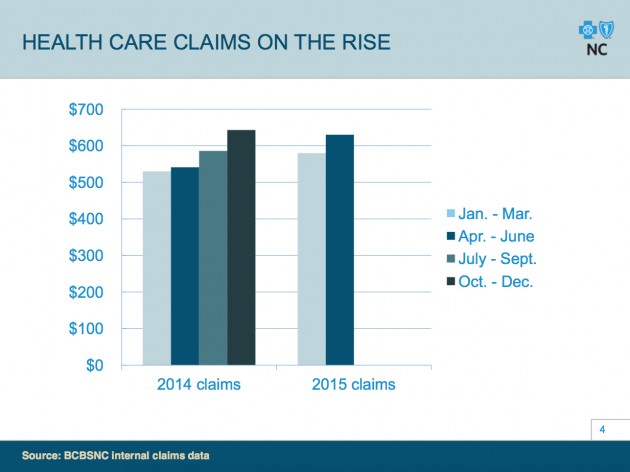
Now that Blue Cross and Blue Shield of North Carolina (BCBS NC) has claims data from the first half of 2015 which reflects more medical utilization among customers compared to 2014, the state's largest insurer is seeking approval for an average 35 percent increase — up from 26 percent — for its Obamacare customer pool to be somewhat sustainable.
 As I've mentioned before
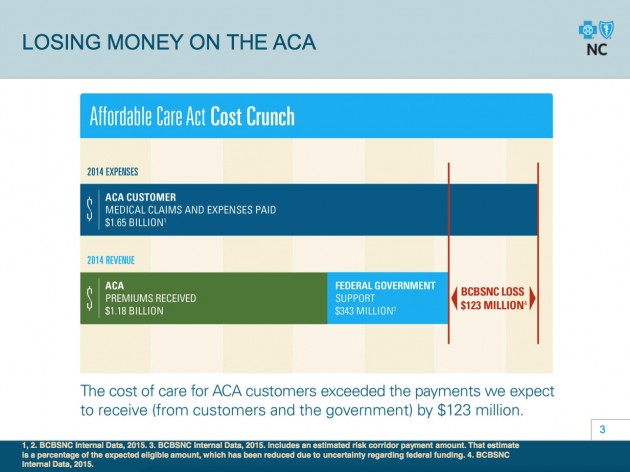
, the rate shock factors in the $343 million worth of Obamacare payouts received in 2014. These funds were provided under the law to prevent initial market volatility when the health insurance exchanges went live in Fall 2013.
The chart below illustrates that, even with these payouts, BCBS NC still lost $123 million from 2014 plans.
To read up on all of the other reasons why insurers and policyholders are facing sustainability issues because of adverse selection, you can read my latest
Spotlight report here.