Publisher's note: The author of this post is Barry Smith, who is an associate editor for the Carolina Journal, John Hood Publisher.
Judge instructs state to begin compensation process for landowners who've been denied use of property within highway corridors
A Superior Court judge has set a timetable for the N.C. Department of Transportation to complete appraisals and begin making deposits to property owners within highway corridors under the state's Map Act.
"This should have been no surprise to the department that this day may someday come," said Matthew Bryant, the lead attorney for the plaintiffs in the case.
"They should have had plans for it."
Under the order issued by Judge John Craig, the DOT has 90 days to make deposits for what the "Kirby 9 plaintiffs," landowners who earlier this year won a lawsuit that was decided by the N.C. Supreme Court. The Supreme Court heard oral arguments on the Map Act in February and ruled unanimously in favor of the plaintiffs in June.
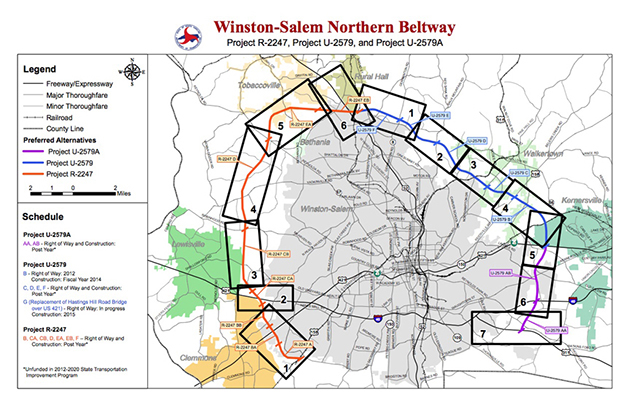
The DOT has seven months to make deposits for other property owners, Craig's order says. The order involves most property owners with land in the Winston-Salem Northern Beltway corridor and the Greensboro Outer Loop corridor.
Similar lawsuits have been filed in Cleveland, Wake, Cumberland, Robeson, and Pender counties involving more than 300 landowners.
The General Assembly enacted the Map Act in 1987. It allows the DOT to file a highway corridor map with local officials and prohibits local governments from issuing building permits or owners from subdividing property within the corridor.
The law was intended to hold down costs to the state for highway projects by preventing development.
The N.C. Supreme Court ruled that by invoking the Map Act, the DOT was taking the plaintiffs' property, which requires just compensation.
The order gives property owners six months to review and conduct their own appraisals once the DOT delivers its deposit and appraisal. Owners then will have one month to notify the DOT whether they accept or reject the valuation as just compensation.
If the owner rejects the valuation, the parties will enter mediation, which must be concluded within six weeks of the property owner's notice of rejection. Cases not resolved at mediation will go to trial.
Bryant said the DOT will have to make hefty interest payments to property owners, as the land was tied up for years by the law and the subsequent lawsuit.
"They have cost the state on these pieces of property somewhere between $50 million and $100 million in interest," Bryant said.
DOT spokesman Steve Abbott said the department is reviewing the Forsyth County ruling, and another Map Act-related ruling from Cleveland County, to determine its next steps.