Governor Signs Bill Requiring Inventory of N.C. Crimes | Eastern NC Now

Gov. Roy Cooper has signed a bill into law that begins cleaning up North Carolina's criminal code

ENCNow
    Publisher's note: The author of this post is Kari Travis, who is an associate editor for the Carolina Journal, John Hood Publisher.

    Gov. Roy Cooper has signed a bill into law that begins cleaning up North Carolina's criminal code.

    The state has too many crimes, lawmakers and legal experts say. Hundreds of these laws are scattered across more than 140 chapters of the N.C. General Statutes. Hundreds more, created by administrative and licensing bodies, cities, towns, and metropolitan sewer districts, cause confusion as to what is - and isn't - a crime.

    House Bill 379, "Recodification Working Group," will require state agencies, boards, and commissions to take inventory of all crimes on their respective books and report to the General Assembly by Dec. 1, 2018.

    The N.C. Administrative Office of the Courts will sort through common law crimes and the general statutes, identifying redundant, inconsistent, obsolete, and unconstitutional crimes. That list would go to the legislature no later than Feb. 1, 2019.

    Many crimes are oddly specific. Larceny, for instance, is a crime already including all theft of personal property. North Carolina, though, has separate offenses for larceny of dairy crates, motor fuel, political signs, and even ginseng, pine needles, and straw.


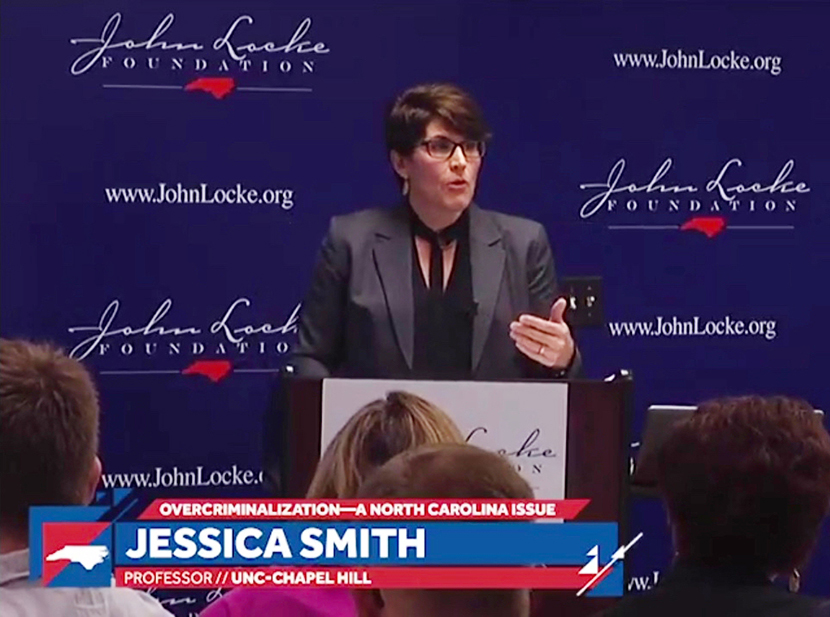
Jessica Smith, Kenan Distinguished Professor at the UNC School of Government, spoke April 9 at the John Locke Foundation on complexities in N.C.'s criminal code. (CJ file photo)

    Some towns have laws against chickens running free. Others criminalize business owners who fail to remove snow from their sidewalks, or punish people who allow female dogs in heat to run free.

    Dysfunction results, said Jessica Smith, professor of public law and government at the UNC School of Government. Smith wrote a 1,000-plus-page book on North Carolina crime laws. The extent of crimes are too much even for an expert to comprehend, much less state residents, Smith said during an April presentation at the John Locke Foundation.

    North Carolinians deserve a transparent, understandable code, Rep. Dennis Riddell, R-Alamance, told Carolina Journal. Riddell, a primary sponsor of H.B. 379.

    "The value to the individual citizens will be a stream-lined transparent and searchable criminal code that any citizen can access," Riddell said.

    "It will improve the efficiency of the entire judicial system and insure a more fair and balanced application of the law. It will protect the individual liberties and rights of every individual citizen."

    Once the state takes inventory of all crimes, a working group will review the findings.

    The working group could consider limiting agencies that try to enact new misdemeanors, since the point of recodification is ensuring the code remains clear and understandable, said Steven Walker, general counsel to Lt. Gov. Dan Forest. Walker was instrumental in the crafting of H.B. 379.
Go Back


Leave a Guest Comment

Your Name or Alias
Your Email Address ( your email address will not be published )
Enter Your Comment ( text only please )


U.S. Supreme Court Punts N.C. Partisan Redistricting Challenge Carolina Journal, Editorials, Op-Ed & Politics House Sends Hunting Amendment to Voters, Voter ID to Senate


HbAD0

Latest Op-Ed & Politics

Spanberger signed HB167, the law that eliminated the tax exemption for various confederacy-linked groups
as RINO incumbents Cornyn in Texas and Cassidy in Louisiana trail in the polls

HbAD1

government's offer is rejected, the battle continues, no confidence vote in parliament

HbAD2


HbAD3


Back to Top