Press Release:
RALEIGH The Child and Adult Care Food Program helps eligible children and adults access healthy, nutritious food by reimbursing qualified child care programs, adult day programs and other non-residential care programs for meals and snacks served to participants. CACFP is administered federally by the U.S. Department of Agriculture and at the state level by the North Carolina Department of Health and Human Services.
CACFP is available to programs that serve children and adults in the following categories who meet federal income requirements:
- Infants and children through age 12 in child care centers and family child care homes
- Children of migrant workers age 15 or younger
- Children age 18 or younger in afterschool care centers and emergency shelters
- Children age 18 or younger with mental or physical disabilities
- Adults 60 years of age or older receiving non-residential care
- Adults age 18 or older living with chronically impairing disabilities
Each year, USDA uses federal poverty information to update the income eligibility guidelines for the CACFP. The latest income guidelines are effective July 1, 2022, through June 30, 2023. The guidelines determine an enrolled participant's eligibility for free and reduced-price meals offered through the CACFP.
Income Eligibility Guidelines
Effective July 1, 2022 - June 30, 2023
Annual Household Income At or Below
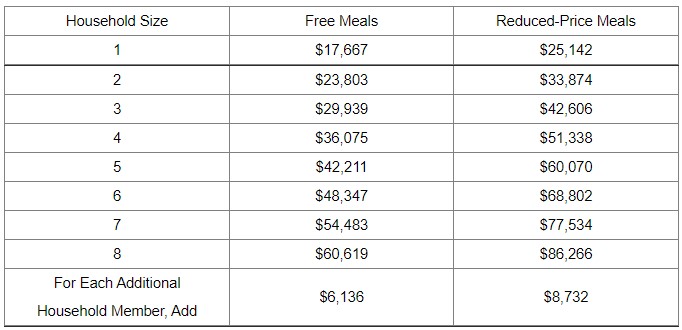
Most child care programs and all family child care homes that participate in CACFP provide meals to all enrolled participants without any separate charge. Reimbursement rates for meals served are based on household incomes of those enrolled for care. Programs and centers interested in participating in CACFP can complete a self-assessment and begin the application process online.
More information on CACFP is available at www.ncdhhs.gov/nccacfp.
As the state agency administering USDA programs, the North Carolina Department of Health and Human Services is prohibited from discriminating. In accordance with federal civil rights law and U.S. Department of Agriculture civil rights regulations and policies, this institution is prohibited from discriminating on the basis of race, color, national origin, sex (including gender identity and sexual orientation), disability, age, or reprisal or retaliation for prior civil rights activity.
Program information may be made available in languages other than English. Persons with disabilities who require alternative means of communication to obtain program information (e.g., Braille, large print, audiotape, American Sign Language), should contact the responsible state or local agency that administers the program or USDA's TARGET Center at (202) 720-2600 (voice and TTY) or contact USDA through the Federal Relay Service at (800) 877-8339.
To file a program discrimination complaint, a Complainant should complete a Form AD-3027, USDA Program Discrimination Complaint Form, which can be obtained online at www.usda.gov/sites/default/files/documents/USDA-OASCR%20P-Complaint-Form-0508-0002-508-11-28-17Fax2Mail.pdf, from any USDA office, by calling (866) 632-9992 or by writing a letter addressed to USDA. The letter must contain the complainant's name, address, telephone number and a written description of the alleged discriminatory action in sufficient detail to inform the Assistant Secretary for Civil Rights (ASCR) about the nature and date of an alleged civil rights violation. The completed AD-3027 form or letter must be submitted to USDA by:
mail:
U.S. Department of Agriculture
Office of the Assistant Secretary for Civil Rights
1400 Independence Avenue, SW
Washington, D.C. 20250-9410; or
fax:
(833) 256-1665 or (202) 690-7442; or
email:
program.intake@usda.gov
This institution is an equal opportunity provider.
- NC Department of Health and Human Services
- 2001 Mail Service Center
- Raleigh, NC 27699-2001
- Ph: (919) 855-4840
- news@dhhs.nc.gov